
This drill copies the style of hands-on exam tasks: short instructions, a clock, and no step-by-step help. Start a 40-minute timer, try each task from memory, and open a solution only when you’re stuck.
1The tasks
| # | Task |
|---|---|
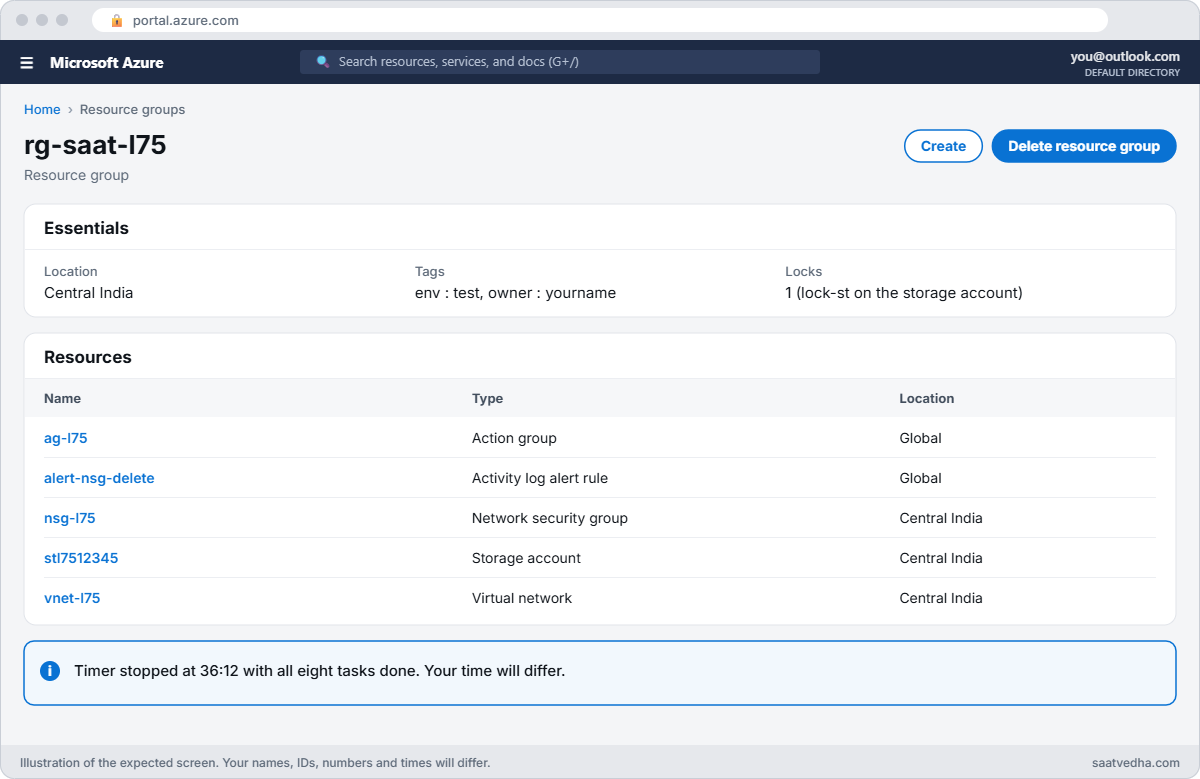
| 1 | Create rg-saat-l75 in Central India with tags env=test and owner=your name. |
| 2 | Create vnet-l75 (10.75.0.0/16) with a private subnet snet-app (10.75.1.0/24). |
| 3 | Create nsg-l75 that allows TCP 443 from VirtualNetwork, and attach it to snet-app. |
| 4 | Create a storage account with public network access disabled and minimum TLS 1.2. |
| 5 | Give yourself Storage Blob Data Reader on that account only. |
| 6 | Create an action group with your email and an activity log alert for NSG deletes in the group. |
| 7 | Allow only Central India in rg-saat-l75 with the built-in Allowed locations policy. |
| 8 | Protect the storage account from deletion with a lock. |
Show the solutions
$sfx = Get-Random -Minimum 10000 -Maximum 99999
az group create --name rg-saat-l75 --location centralindia --tags env=test owner=yourname course=saatvedha-azure -o none
az network vnet create --resource-group rg-saat-l75 --name vnet-l75 --address-prefixes 10.75.0.0/16 --subnet-name snet-app --subnet-prefixes 10.75.1.0/24 -o none
az network vnet subnet update --resource-group rg-saat-l75 --vnet-name vnet-l75 --name snet-app --default-outbound-access false -o none
az network nsg create --resource-group rg-saat-l75 --name nsg-l75 -o none
az network nsg rule create --resource-group rg-saat-l75 --nsg-name nsg-l75 --name allow-https-vnet --priority 100 --direction Inbound --access Allow --protocol Tcp --source-address-prefixes VirtualNetwork --destination-port-ranges 443 -o none
az network vnet subnet update --resource-group rg-saat-l75 --vnet-name vnet-l75 --name snet-app --network-security-group nsg-l75 -o none
az storage account create --resource-group rg-saat-l75 --name stl75$sfx --sku Standard_LRS --min-tls-version TLS1_2 --public-network-access Disabled --allow-blob-public-access false -o none
$stId = az storage account show --resource-group rg-saat-l75 --name stl75$sfx --query id -o tsv
$me = az ad signed-in-user show --query id -o tsv
az role assignment create --assignee-object-id $me --assignee-principal-type User --role "Storage Blob Data Reader" --scope $stId -o none
az monitor action-group create --resource-group rg-saat-l75 --name ag-l75 --short-name agl75 --action email me you@example.com -o none
$rgId = az group show --name rg-saat-l75 --query id -o tsv
$agId = az monitor action-group show --resource-group rg-saat-l75 --name ag-l75 --query id -o tsv
az monitor activity-log alert create --resource-group rg-saat-l75 --name alert-nsg-delete --scope $rgId --condition category=Administrative and operationName=Microsoft.Network/networkSecurityGroups/delete --action-group $agId -o none
'{"listOfAllowedLocations":{"value":["centralindia"]}}' | Set-Content C:\azure-lab\l75-loc.json
az policy assignment create --name allowed-loc-l75 --policy e56962a6-4747-49cd-b67b-bf8b01975c4c --scope $rgId --params '@C:\azure-lab\l75-loc.json' -o none
az lock create --name lock-st --lock-type CanNotDelete --resource-group rg-saat-l75 --resource-name stl75$sfx --resource-type Microsoft.Storage/storageAccounts -o none2Check your work
Run these checks and compare:
az group show --name rg-saat-l75 --query tags
az network vnet subnet show --resource-group rg-saat-l75 --vnet-name vnet-l75 --name snet-app --query "{nsg:networkSecurityGroup.id, defaultOutbound:defaultOutboundAccess}" -o json
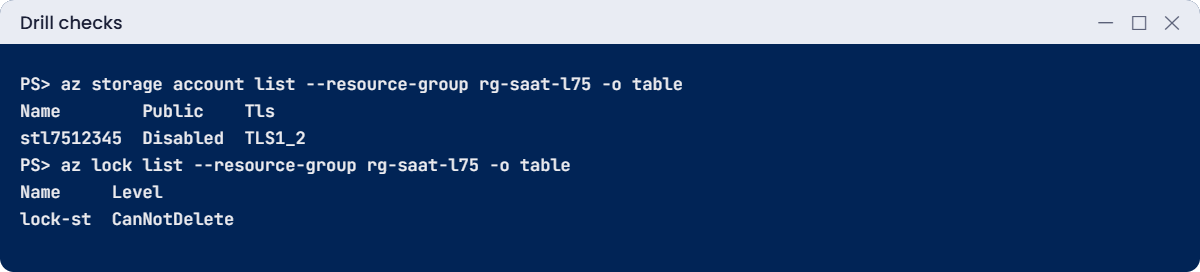
az storage account list --resource-group rg-saat-l75 --query "[].{name:name, public:publicNetworkAccess, tls:minimumTlsVersion}" -o table
az lock list --resource-group rg-saat-l75 --query "[].{name:name, level:level}" -o table
You should see something like this:
{
  "course": "saatvedha-azure",
  "env": "test",
  "owner": "yourname"
}
{
  "nsg": "/subscriptions/.../networkSecurityGroups/nsg-l75",
  "defaultOutbound": false
}
Name        Public    Tls
----------  --------  ------
stl7512345  Disabled  TLS1_2
Name     Level
-------  -------------
lock-st  CanNotDelete
Finished in 40 minutes? You’re at exam speed. If not, repeat the drill in a week; the second run is always faster.
✅ Checkpoint: You completed eight admin tasks against the clock and verified each one from the CLI.
1Break it: clean-up refused
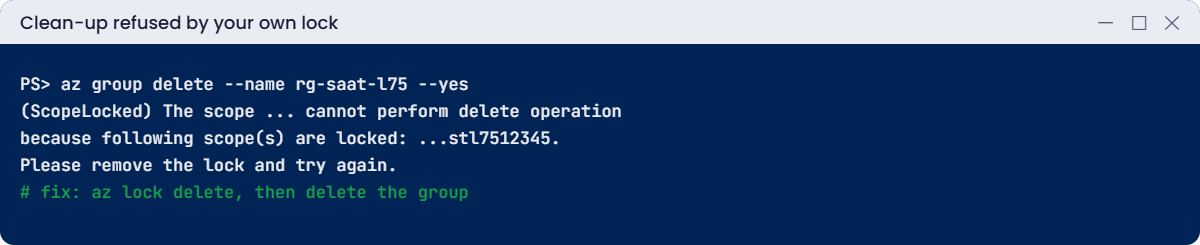
Try to delete the drill group:
az group delete --name rg-saat-l75 --yesYou’ll get an error like this:
(ScopeLocked) The scope '/subscriptions/.../resourceGroups/rg-saat-l75' cannot perform delete operation because following scope(s) are locked: '/subscriptions/.../resourceGroups/rg-saat-l75/providers/Microsoft.Storage/storageAccounts/stl7512345'. Please remove the lock and try again.Your own lock from task 8 did its job. Interviewers like this one: a lock protects against everyone, including Owners, and the error names exactly which lock to look at.
Fix it: remove the lock, then delete the group and the policy assignment:
az lock delete --name lock-st --resource-group rg-saat-l75 --resource-name stl75$sfx --resource-type Microsoft.Storage/storageAccounts
az policy assignment delete --name allowed-loc-l75 --scope $rgId
az group delete --name rg-saat-l75 --yes2Break it: a design an interviewer hands you
Senior interviews often show a design with mistakes and ask what you’d change. Read this one, list every problem you can find, then open the answer.
The design to review
“Our shop runs on one Standard_B2s VM in a public subnet with a public IP. RDP is open to the internet so the vendor can log in. The app reads the storage account key from a config file on the VM.
Nightly reports run on the same VM. The database VNet uses 10.0.0.0/16, and we plan to peer it with the office VNet, also 10.0.0.0/16. Backups: we take a snapshot when we remember.”
Show the problems and fixes
| Problem | Why it matters | Fix |
|---|---|---|
| Single VM | No redundancy; any reboot is an outage | Two VMs across zones behind a load balancer (Lessons 18, 51) |
| RDP open to the internet | Attacked within minutes | Bastion or JIT, no public IP (Lessons 27, 28) |
| Storage key in a config file | Leaks give full account access | Managed identity with a data role, or Key Vault (Lessons 10, 55) |
| Reports on a B-series VM | Credits run out; slow by mid-week | Separate non-burstable size or scheduled job (Lesson 72) |
| Overlapping 10.0.0.0/16 ranges | Peering will fail | Plan non-overlapping ranges (Lessons 45, 46) |
| Snapshots “when we remember” | No reliable restore point | Azure Backup policy, tested restores (Lessons 35, 69) |
3Break it: the troubleshooting question
Practise answering out loud: “Users say the website on Azure is down. Walk me through what you do.” Give your answer in order, then compare.
Show a strong answer
- Scope it: which URL, which users, since when (in UTC), all or some requests.
- Check Service Health for the region and Resource Health for the front door, load balancer or gateway and VMs.
- Ask what changed: Activity log for the resource groups involved (Lesson 59).
- Follow the path: DNS, public IP, load balancer or gateway health and probes, NSGs, routes, then the VMs and the app (Lessons 51, 61, 62, 71).
- Fix, confirm the way users do, and write down the cause and prevention.
✅ Checkpoint: You cleared your own lock, reviewed a flawed design like a senior engineer, and gave a structured troubleshooting answer.
30 rapid-fire Azure interview questions
Cover the answers and test yourself. Each one is answered in more depth somewhere in this course.
| Question | Short answer |
|---|---|
| What is the difference between a resource group and a subscription? | A subscription is a billing and quota boundary; resource groups organise resources inside it for lifecycle and access. |
| Name the four Azure RBAC scopes. | Management group, subscription, resource group, resource. |
| What is the difference between RBAC and Azure Policy? | RBAC controls who can act; Policy controls what may exist and how it is configured. |
| System-assigned vs user-assigned managed identity? | System-assigned lives and dies with one resource; user-assigned is a separate resource shared by many. |
| What do NSGs filter? | Inbound and outbound traffic by source, destination, port and protocol, on subnets and NICs. |
| What is an application security group? | A label for NICs so NSG rules can target groups of VMs instead of IPs. |
| Why use NAT Gateway? | Predictable outbound IPs and plenty of SNAT ports for private subnets. |
| Availability set vs availability zone? | Sets spread VMs across fault and update domains in one datacentre; zones spread them across separate datacentres. |
| What does deallocating a VM stop? | Compute charges; disks and Standard public IPs still bill. |
| LRS, ZRS, GRS? | Three copies in one datacentre, across zones, or also copied to a paired region. |
| Hot, Cool, Cold, Archive? | Access tiers with falling storage price and rising access cost; Archive needs rehydration. |
| User delegation SAS vs account SAS? | User delegation SAS is signed with an Entra ID key and can be revoked; account SAS uses the account key. |
| Service endpoint vs private endpoint? | A service endpoint lets a subnet reach the public endpoint privately; a private endpoint gives the service a private IP in your VNet. |
| Why do private endpoints need DNS? | Clients must resolve the normal service name to the private IP through a privatelink zone. |
| Is VNet peering transitive? | No. Spokes need routing through a hub appliance or direct peering. |
| What does a user-defined route do? | Overrides Azure’s default path for a prefix, for example sending traffic to a firewall. |
| VPN Gateway vs ExpressRoute? | VPN is encrypted over the internet; ExpressRoute is a private provider link with BGP and an SLA. |
| Load Balancer vs Application Gateway? | Layer 4 for any TCP or UDP; Layer 7 for HTTP with path routing and WAF. |
| What causes a 502 on Application Gateway? | No healthy backend, or a request that times out or fails. |
| What does Azure Bastion give you? | RDP and SSH through the portal or native client without public IPs on VMs. |
| What is just-in-time VM access? | Defender for Cloud opens management ports only on request, for a limited time and source. |
| What does Azure Monitor Agent need? | The extension, an identity, a DCR association and a network path. |
| What is a data collection rule? | The definition of what to collect and where to send it, associated with machines. |
| What is the Activity log for? | Control-plane operations: who did what, when, kept 90 days. |
| Azure Backup vs Azure Site Recovery? | Backup restores data from points in time; Site Recovery replicates VMs for failover to another region. |
| What is soft delete in Key Vault? | Deleted vaults and objects are kept for 7 to 90 days and can be recovered. |
| Why use Bicep? | Readable infrastructure as code that compiles to ARM, with modules, what-if and type checks. |
| What does what-if show? | The changes a deployment would make before you run it. |
| What is a 429? | Throttling: slow down and retry after the time the service gives. |
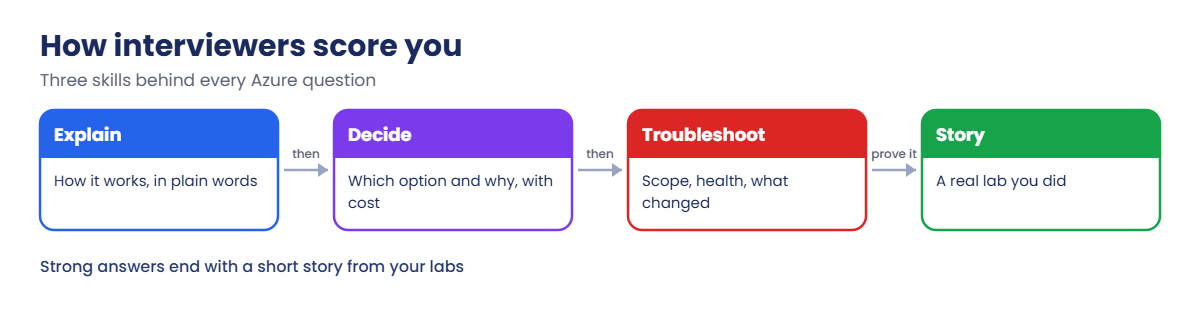
| How do you start any troubleshooting? | Scope the problem, check whether Azure is healthy, then find what changed. |