Interview and Certification Prep
-
Phase 0: Before you start
-
Phase 1: The foundation
-
Phase 2: Operations and security
-
Phase 3: SQL Server on AWS
-
Phase 4: Troubleshooting step by step
-
Phase 5: Final project and career
You’ve built, broken and fixed a lot of AWS in this course. Good answers to AWS interview questions come from exactly that: clear explanations of how things work, a calm method for troubleshooting live, and real stories with real evidence. This last lesson turns your work into all three, and plans your first certification.
You’ll build an “experience map” of what you’ve changed in AWS from CloudTrail, audit what the course left in your account, and write an interview notes file with five ready-made stories. Then you’ll fix two inventory traps, and finish with a study plan for the CloudOps Engineer Associate (SOA-C03) and Solutions Architect Associate (SAA-C03) exams.
| Time | You need | By the end you can |
|---|---|---|
| 90 minutes, plus your study weeks | Lessons 1 to 69 done (or as many as you’ve finished), saat-trail logging, Find-Spenders.ps1, signed in as saat-admin. Cost: a few cents at most (a short-lived empty bucket and some API calls). | Explain AWS concepts clearly at three levels, answer scenario questions with a method, back your experience with evidence from CloudTrail, audit an account by tags, and plan for SOA-C03 and SAA-C03. |
What it is, in one line
AWS interview questions test three things: whether you understand how services work, whether you can troubleshoot methodically, and whether you have real experience to talk about.
In Simple Words
Cooking in front of judges
A cooking competition doesn’t only ask “what is a sauce?” The judges watch you cook, ask why you added salt when you did, and ask about a dish that went wrong once and what you learned.
AWS interviews are the same. Definitions get you through the first round. The later rounds want to see you think, and to hear about real kitchens you’ve worked in.
This course was your kitchen. Now you’ll write down the recipes and the burnt dishes, so you can talk about them calmly.
Engineer's View
What interviewers and exams check
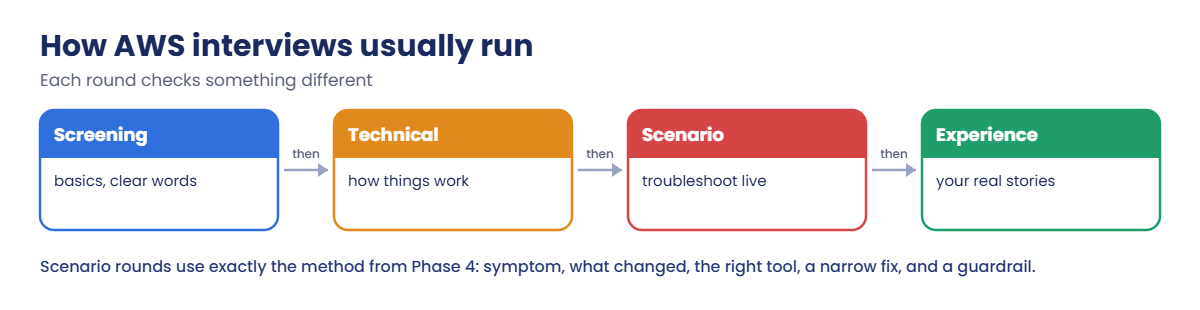
Fresher rounds check basics in plain words: regions and AZs, IAM users vs roles, VPC pieces, security groups vs NACLs, EBS vs S3, RDS vs EC2. Mid-level rounds (2 to 5 years) check troubleshooting: an instance you can’t reach, an AccessDenied, a 502, a slow database, a failed stack. Senior rounds check design and judgement: multi-account governance, DR, cost, and how you lead an incident.
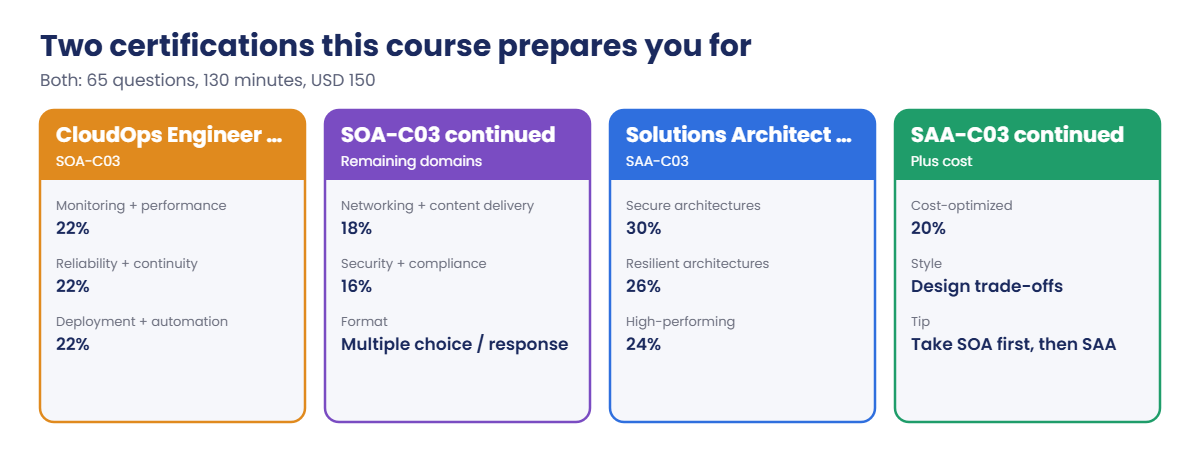
The AWS Certified CloudOps Engineer – Associate (SOA-C03), renamed from SysOps Administrator, has 65 multiple-choice and multiple-response questions in 130 minutes for USD 150, across monitoring (22%), reliability (22%), deployment and automation (22%), networking (18%) and security (16%). The Solutions Architect – Associate (SAA-C03) has the same length and price, weighted to secure (30%), resilient (26%), high-performing (24%) and cost-optimized (20%) architectures. Check the official exam guides before you book, as versions change.
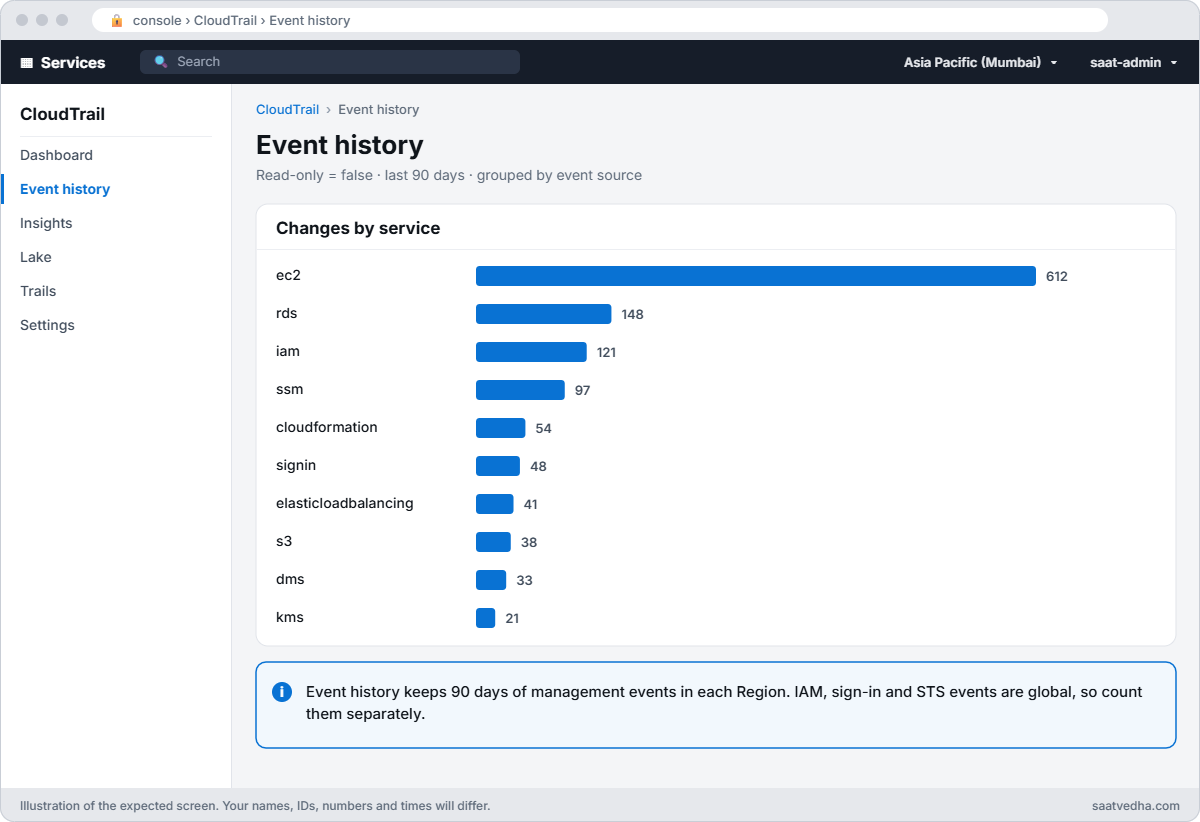
Every interview answer is stronger with evidence. CloudTrail already holds a record of the changes you made during this course, and your break-and-fix notes are ready-made stories.
How it works, step by step
Here is how to answer the three kinds of questions.
1Concept questions
One plain sentence, then one technical detail, then one real example. “A security group is a stateful firewall on an ENI; replies are allowed automatically; I used one to allow 1433 only from the app tier.”
2Scenario questions
Say your method out loud: symptom, what changed, which layer, which tool, the narrow fix, and the guardrail. Interviewers grade the method more than the final answer.
3Experience questions
Use a short story: situation, what you checked, cause, fix, and what you changed afterwards. Numbers help: “40 seconds of failover”, “3 reads instead of 812”.
4Pick your certifications
Two associate exams fit this course:
SOA-C03 matches this course most closely, so take it first. SAA-C03 adds more design trade-offs and pairs well with it.
✅ Checkpoint: You can answer a concept question in three sentences, describe your troubleshooting method, and name the SOA-C03 domains.
Hands-on lab: build your evidence and interview notes
Sign in and add the helpers:
cd C:\aws-lab
aws login --profile saat-admin
$env:AWS_PROFILE = 'saat-admin'
$acct = aws sts get-caller-identity --query Account --output text
function Get-ExperienceMap([string]$Region = 'ap-south-1', [int]$Days = 90) {
$s = (Get-Date).ToUniversalTime().AddDays(-$Days).ToString('o')
$src = aws cloudtrail lookup-events --region $Region --lookup-attributes AttributeKey=ReadOnly,AttributeValue=false --start-time $s --max-results 3000 --query "Events[].EventSource" --output text
($src -split '\s+') | Where-Object { $_ } | ForEach-Object { $_ -replace '\.amazonaws\.com$', '' } | Group-Object | Sort-Object Count -Descending | Select-Object -First 10 @{ n = 'Service'; e = { $_.Name } }, @{ n = 'Changes'; e = { $_.Count } }
}
function Get-TagInventory {
$arns = aws resourcegroupstaggingapi get-resources --tag-filters Key=course,Values=saatvedha-aws --query "ResourceTagMappingList[].ResourceARN" --output text
($arns -split '\s+') | Where-Object { $_ } | ForEach-Object { ($_ -split ':')[2] } | Group-Object | Sort-Object Count -Descending | Select-Object @{ n = 'Service'; e = { $_.Name } }, @{ n = 'Tagged'; e = { $_.Count } }
}1Build your experience map
Paste this whole block. IAM and other global services log in us-east-1, so it checks both Regions (each takes a minute or so):
$map = Get-ExperienceMap
$map | Format-Table -AutoSize
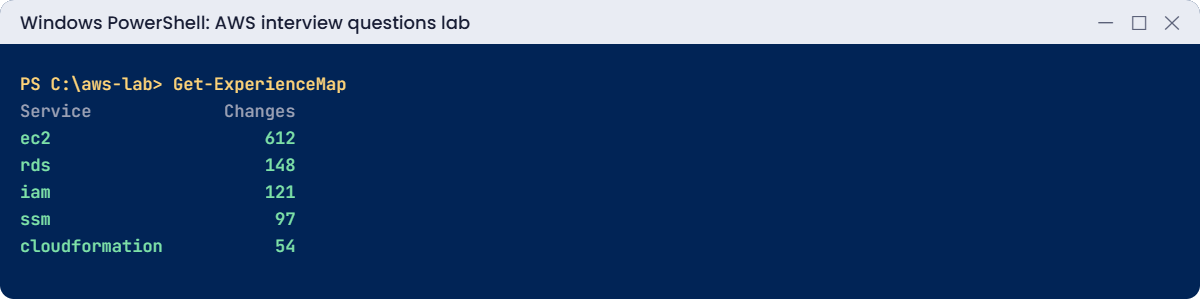
Get-ExperienceMap -Region us-east-1 | Select-Object -First 3 | Format-Table -AutoSizeYou should see something like this:
Service Changes
------- -------
ec2 612
rds 148
ssm 97
cloudformation 54
elasticloadbalancing 41
s3 38
dms 33
kms 21
logs 17
monitoring 15
Service Changes
------- -------
iam 121
signin 48
sts 12That’s your hands-on record in numbers: hundreds of changes across a dozen services. Interviewers can’t see your account, but you can say “I’ve made over 600 EC2 API changes building and breaking labs” and back it up.
2Audit what the course left in your account
Paste this whole block:
Get-TagInventory | Format-Table -AutoSize
.\Find-Spenders.ps1 -Regions ap-south-1You should see something like this:
Service Tagged
------- ------
ec2 24
s3 2
cloudtrail 1
sns 1
iam 3
Nothing running or left behind in 1 Regions.What remains is the foundation you kept on purpose: saat-vpc and its security groups, the trail and its bucket, the saat-alerts topic, roles, budgets and the anomaly monitor. None of it runs servers.
If you’ve finished with the account, delete in this order: anything Find-Spenders lists, the CDKToolkit stack (Lesson 35), the trail and its bucket, then the VPC; or close the account from the billing console. Otherwise keep it for practice.
3Write your interview notes
Paste this whole block. It writes a notes file with your experience map and five stories from the course; edit them in your own words afterwards:
$notes = @'
# My AWS interview notes
## What I built (from CloudTrail, last 90 days)
EXPERIENCE_HERE
## Stories (situation, what I checked, cause, fix, guardrail)
| # | Situation | What I checked | Cause | Fix | Guardrail |
|---|---|---|---|---|---|
| 1 | Half the web servers unhealthy (final project scenario 4) | Target health, subnet, NACL | NACL without outbound ephemeral | Restored original NACL | NACL changes through review |
| 2 | New servers kept cycling (scenario 10) | Scaling activities, console output | CRLF user data in a new launch template version | Rolled ASG back to version 1 | Lint user data in the pipeline |
| 3 | RDS SQL Server high CPU (Lesson 65) | Database Insights, Query Store | nvarchar parameter vs varchar column | Matched parameter types | Code review for parameter types |
| 4 | DMS CDC task failed after a weekend (Lesson 64) | LastFailureMessage, log backups | Log backups deleted while task stopped | reload-target | Keep tasks running, alert on stop |
| 5 | Unexpected charges (Lesson 68) | Cost Explorer, Find-Spenders | Elastic IP left after NAT deletion | Released it | Anomaly detection, daily sweep |
'@
$notes.Replace('EXPERIENCE_HERE', ($map | Format-Table -AutoSize | Out-String).Trim()) | Set-Content C:\aws-lab\interview-notes.md
Get-Content C:\aws-lab\interview-notes.md | Select-Object -First 8You should see something like this:
# My AWS interview notes
## What I built (from CloudTrail, last 90 days)
Service Changes
------- -------
ec2 612
rds 148
ssm 97Practise each story out loud in under two minutes. Here are the questions you’re most likely to be asked, and where you already practised each one:
| Question | Where you practised it |
|---|---|
| How do you secure a new AWS account? | Lessons 2, 6, 33 |
| Security groups vs network ACLs? | Lessons 10, 57 |
| You can’t SSH or RDP to an instance. What do you check? | Lesson 57 |
| How do you find out who changed something? | Lessons 25, 56 |
| AccessDenied: how do you troubleshoot it? | Lessons 7, 59 |
| S3 returns 403. Why might that be? | Lessons 17, 60 |
| RDS or EC2 for SQL Server? | Lesson 40 |
| How do you migrate SQL Server to AWS with little downtime? | Lessons 46 to 48 |
| How do you restore a database to a point in time? | Lesson 52 |
| How does Multi-AZ failover work? | Lesson 54 |
| A database is slow. Where do you start? | Lessons 51, 65 |
| What do ALB 502, 503 and 504 mean? | Lesson 66 |
| A CloudFormation stack is stuck. What now? | Lesson 67 |
| How do you control costs? | Lessons 36, 68 |
4Plan your exam
A four-week plan for SOA-C03, built on what you’ve done:
| Week | Focus | Do this |
|---|---|---|
| 1 | Monitoring and reliability (44%) | Re-run Lessons 23, 24, 29, 52, 54; write one alarm and one restore from memory |
| 2 | Deployment and automation (22%) | Re-run Lessons 27, 28, 34, 35; deploy and roll back a stack |
| 3 | Networking and security (34%) | Re-run Lessons 8 to 10, 30, 31, 57 to 59; draw saat-vpc from memory |
| 4 | Practice and review | Official practice question set, review every wrong answer against a lesson, book the exam |
Book the exam at the start of week 4 so the date keeps you honest. After SOA-C03, the same habits carry you through SAA-C03.
✅ Checkpoint: Your experience map lists your top services, the tag inventory and Find-Spenders show only what you kept on purpose, and C:\aws-lab\interview-notes.md holds your map and five stories.
Break It, Then Fix It
Two traps you’ll hit when you audit a real account, which also make good interview stories.
1Break it: CloudTrail throttling
Run four lookups at once with retries turned off, as a hurried script might:
$s = (Get-Date).ToUniversalTime().AddDays(-30).ToString('o')
1..4 | ForEach-Object { Start-Job -ArgumentList $s -ScriptBlock { param($s) $env:AWS_MAX_ATTEMPTS = '1'; aws cloudtrail lookup-events --lookup-attributes AttributeKey=ReadOnly,AttributeValue=false --start-time $s --max-results 1000 --query "length(Events)" --output text 2>&1 | Out-String } } | Out-Null
Get-Job | Wait-Job | Receive-Job; Get-Job | Remove-JobYou’ll get something like this:
1000
An error occurred (ThrottlingException) when calling the LookupEvents operation: Rate exceeded
1000CloudTrail’s LookupEvents allows only a couple of requests per second per account and Region, and each page holds 50 events. Parallel scripts and dashboards hit that limit constantly. Fix: let the CLI back off and retry, and run one lookup at a time (or use CloudTrail Lake or Athena for big searches):
$env:AWS_RETRY_MODE = 'adaptive'; $env:AWS_MAX_ATTEMPTS = '10'
aws cloudtrail lookup-events --lookup-attributes AttributeKey=ReadOnly,AttributeValue=false --start-time $s --max-results 1000 --query "length(Events)" --output text
Remove-Item Env:AWS_RETRY_MODE, Env:AWS_MAX_ATTEMPTSYou should see this:
10002Break it: something the tag inventory can’t see
Create a bucket without the course tag, then look for it both ways:
$ub = "saat-untagged-$acct-ap-south-1-an"
aws s3api create-bucket --bucket $ub --bucket-namespace account-regional --region ap-south-1 --create-bucket-configuration LocationConstraint=ap-south-1 | Out-Null
aws resourcegroupstaggingapi get-resources --tag-filters Key=course,Values=saatvedha-aws --resource-type-filters s3 --query "ResourceTagMappingList[].ResourceARN" --output text
aws s3api list-buckets --query "Buckets[?starts_with(Name, 'saat-untagged')].Name" --output textYou’ll get something like this:
arn:aws:s3:::saat-trail-111122223333-ap-south-1-an
saat-untagged-111122223333-ap-south-1-an

The tag inventory only knows tagged resources, so anything created without tags is invisible to tag-based reports, budgets and cleanup scripts. In real accounts that’s how “nobody owns this” resources pile up. Fix: tag it (or delete it), and enforce tags at creation with tag policies or a Config required-tags rule:
aws s3api put-bucket-tagging --bucket $ub --tagging 'TagSet=[{Key=course,Value=saatvedha-aws},{Key=lesson,Value=70}]'
aws resourcegroupstaggingapi get-resources --tag-filters Key=course,Values=saatvedha-aws --resource-type-filters s3 --query "length(ResourceTagMappingList)" --output text
aws s3 rb "s3://$ub"You should see something like this:
2
remove_bucket: saat-untagged-111122223333-ap-south-1-an✅ Checkpoint: You beat CloudTrail throttling with adaptive retries and one lookup at a time, and found an untagged bucket that tag reports couldn’t see. The test bucket is deleted.
This happened at work
The interview that turned on one story
A support engineer from a small Mumbai IT firm applied for a cloud operations role at a bank. The first rounds went fine but felt generic; many candidates knew the same definitions.
In the final round, the panel asked about a time something broke. She described a database restore that failed at 2 a.m. with Access Denied, how she checked the option group’s role instead of her own permissions, found the missing GetObject, fixed it narrowly, and added a pre-flight check to the runbook. She had the exact commands and the time it took.
The hiring manager said later that this one story showed method, calm and ownership better than any certificate. She got the offer, and passed SOA-C03 two months later.
Common mistakes and troubleshooting
| Mistake | What happens | What to do |
|---|---|---|
| Memorising definitions only | Stuck in scenario rounds | Practise saying your method out loud |
| Answering “I would add admin rights” | Instant red flag | Narrow fixes and least privilege, always |
| Stories without detail | Sounds made up | Commands, numbers, times, what changed after |
| Booking the exam with no date pressure | Study drifts for months | Book at the start of the final study week |
| Leaving lab resources running | A surprise bill | Find-Spenders and tag inventory before you stop |
| Pretending to know | Trust lost | Say what you’d check and how you’d find out |
Interview questions
Click a question to open it. Each one is written the way an interviewer would ask it. Under it you will see why they ask it and one way you could answer, in your own words.
Fresher level
1. Can you explain in simple words the difference between a Region and an Availability Zone?
Why they ask this: They want to check that you understand the basic layout of AWS, because every HA and DR design builds on it.
How you might answer: A Region is a geographic area, like Mumbai, and it contains several isolated Availability Zones. Each AZ is one or more data centres with their own power and networking.
The AZs in a Region are linked with low latency, so I can spread an app across them and survive one AZ failing.
2. What’s the difference between an IAM user and an IAM role, and when would you use each?
Why they ask this: They want to see that you understand long-term and temporary credentials, and prefer the safer option.
How you might answer: An IAM user has long-term credentials for one person or app. A role is something you assume to get temporary credentials, and people, AWS services or other accounts can assume it.
I prefer roles wherever possible, for example an instance role for an app on EC2 instead of stored access keys.
3. How would you explain a VPC to someone who isn’t technical?
Why they ask this: They want to see if you can explain technical ideas simply, which matters when you talk to managers and customers.
How you might answer: I’d say a VPC is your own private section of the AWS network, like your own office building. The subnets are the rooms, the gateways are the doors, and security groups and NACLs are the guards.
Nobody gets in or out unless you’ve allowed it.
2–5 years experience
4. Tell me about a production issue you fixed.
Why they ask this: They want to hear how you think through a real problem, step by step, and whether you prevent it from coming back.
How you might answer: I’d pick one real story and tell it in order: the situation, what I checked first and why, and the evidence I found. For example, a nightly job stopped after a Multi-AZ failover, and the evidence showed the Agent jobs weren’t on the new primary.
Then I’d explain the cause, the narrow fix I made, and the guardrail I added afterwards, like turning on job sync and adding a failover checklist.
5. How do you make sure your changes don’t break production?
Why they ask this: They want to see that you have safe habits for change, and a way back when something goes wrong.
How you might answer: I make changes through IaC and look at the change set before running it, and another engineer reviews it. I roll out in stages, starting with test environments.
Health checks and alarms tell me quickly if something breaks, and I always have a rollback that I’ve tested.
6. Say you join our team next week. What would you do in your first week on our AWS accounts?
Why they ask this: They want to see your judgement, and that you learn the environment before you start changing things.
How you might answer: I’d learn the architecture and read the runbooks first. Then I’d check access, logging, backups and alarms, and look for resources that are untagged or have no owner.
I’d write down what I find and ask before changing anything.
Senior level
7. A major incident hits and you’re asked to lead the response. How would you run it?
Why they ask this: They want to see that you can organise people under pressure, communicate clearly, and focus on recovery before blame.
How you might answer: First I assign roles: an incident lead, someone on communications, and investigators. I keep a timeline and send updates on a fixed schedule, so nobody has to chase us.
We focus on getting service back first, and look for the root cause after. Then I run a blameless review that ends with clear actions.
8. How do you decide between building something yourself and using a managed AWS service?
Why they ask this: They want to see that you weigh the real costs and risks of each choice and can defend the decision to a team.
How you might answer: I compare the operational effort, the features and limits, the cost at the scale we expect, the team’s skills, and how easy it is to leave later.
My default is the managed service, unless a clear requirement rules it out.
Quick quiz
Q1. How many questions does SOA-C03 have?
- 50
- 65
- 85
- 100
Show answer
B — 65 questions in 130 minutes.
Q2. Which SOA-C03 domain carries the smallest weight?
- Monitoring
- Security and compliance (16%)
- Deployment
- Reliability
Show answer
B — Security and compliance is 16%.
Q3. Why did some parallel lookups fail?
- Wrong Region
- CloudTrail API throttling
- No permission
- Trail stopped
Show answer
B — LookupEvents has a low request rate.
Q4. Why didn’t the tag inventory show the new bucket?
- It was empty
- It had no tags
- Wrong Region
- S3 is global
Show answer
B — Tag reports only see tagged resources.
Q5. What makes an experience story convincing?
- Big words
- Commands, numbers and what you changed afterwards
- Certificates
- Length
Show answer
B — Specific evidence.
Quick recap
- Answer concepts in three sentences: plain, technical, example.
- Answer scenarios with your method, out loud.
- Back experience with stories and CloudTrail evidence.
- Audit your account by tags and with an all-Region sweep before you stop.
- Take SOA-C03 first, then SAA-C03, with a booked date.
What’s next
You’ve finished AWS Cloud Administration. Keep your interview notes up to date, re-run a Phase 4 lab whenever an interview is coming, and go back to the course overview to revisit any lesson.
Further reading: AWS interview questions
Want to go deeper into AWS interview questions? Read AWS Certified CloudOps Engineer – Associate and AWS Certified Solutions Architect – Associate. You can also see the full plan for this course on the AWS Cloud Administration course page.
