NetApp certifications: every exam and how to prepare
-
Phase 0: Start here
-
Phase 1: Architecture and foundation
-
Phase 2: Protocols and day-to-day administration
-
Phase 3: Data protection and enterprise integrations
-
Phase 4: Troubleshooting blueprint
-
Phase 5: Final project and career
NetApp doesn’t have one certificate. It has about twenty, split into professional, specialist and expert levels, plus two short associate accreditations. Each one fits a different job: admin, installer, support engineer, SAN or data protection specialist, cloud engineer, architect or AI and security expert.
This page lists every current NetApp certification, the exam behind it, what it covers and which of our lessons prepare you for it. Exam codes and prices change, so check each one on NetApp’s certification site before you book.
Where this page fits
Deep dive in NetApp ONTAP Storage Administration · Phase 5, Final project and career · Before this: Lesson 56, NetApp interview questions · Next: back to the course overview
| Time | You need | By the end you can |
|---|---|---|
| 45 minutes to read, then a study plan per exam | The practice shell from this course | Pick the right NetApp exam for your job, map its objectives to lessons and plan your preparation |
What it is, in one line
A NetApp certification is a proctored exam that proves you can do one specific NetApp job, and each job has its own exam.
In Simple Words
Driving licences for storage
In many countries one driving test isn’t enough for every vehicle. A car licence doesn’t let you drive a bus, and a bus licence doesn’t let you fly a plane.
NetApp works the same way. The Data Administrator exam is the car licence most people start with. The SAN, data protection and MetroCluster exams are the bus licences you add later, and the cloud, AI and cyber exams are different vehicles altogether.
Engineer's View
How the programme works in 2026
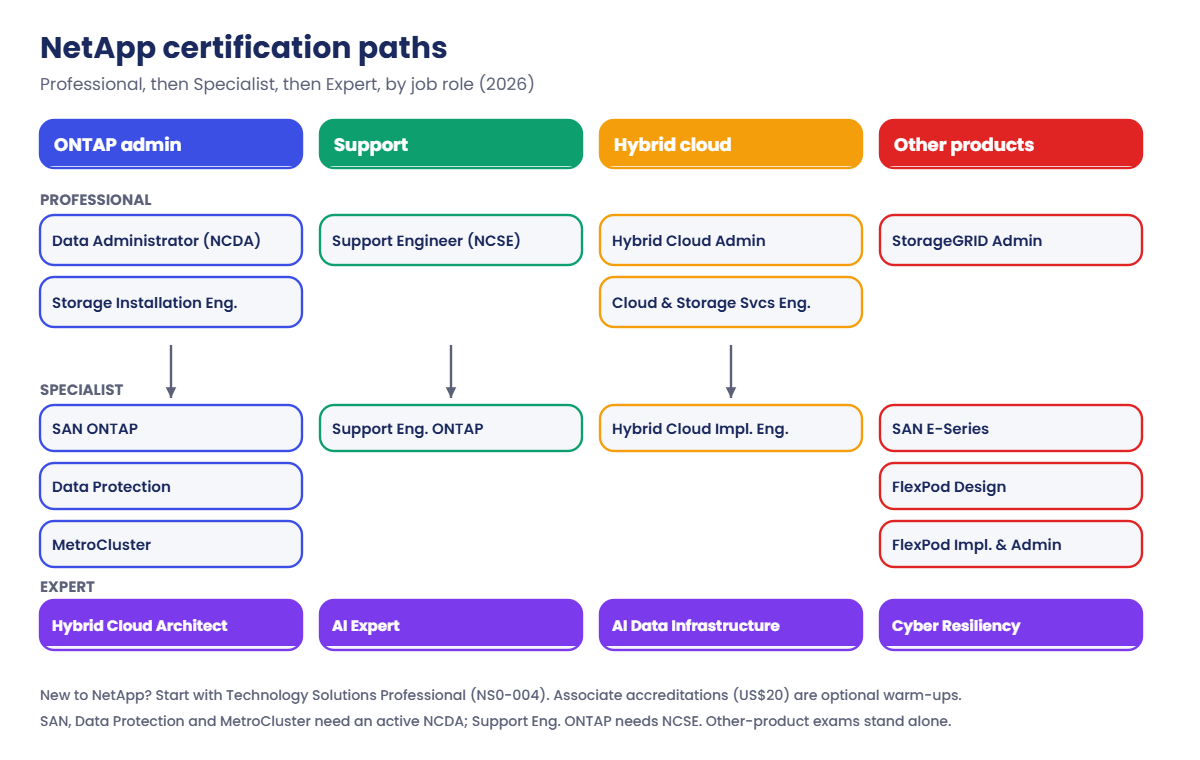
NetApp sorts its certifications into three tiers: Professional (job-role exams such as Data Administrator), Specialist (deeper exams that often need a professional certificate first) and Expert (AI, AI data infrastructure, cyber resiliency and hybrid cloud architect).
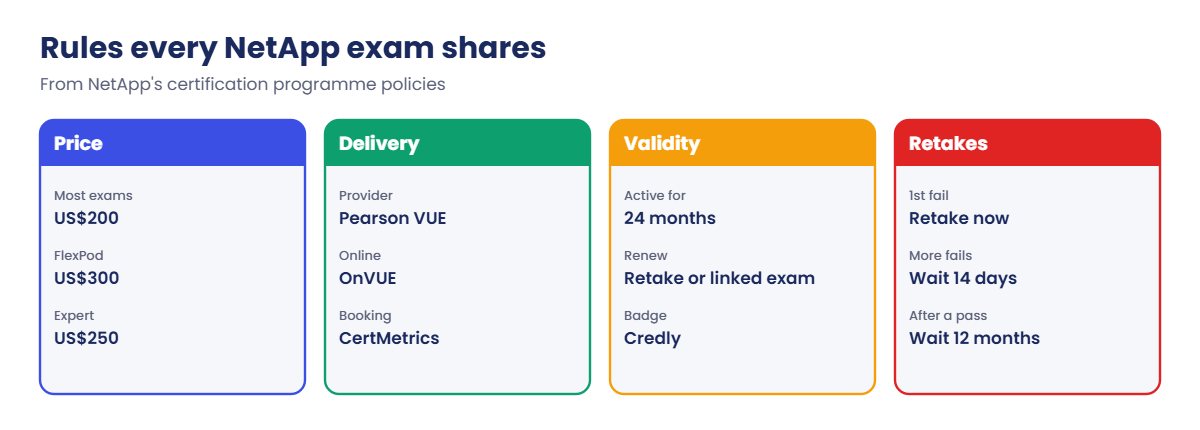
NetApp’s policy page lists certification exams at US$200, the Cisco FlexPod exams at US$300 and the expert exams at US$250. The two associate accreditations, Hybrid Cloud Associate and Cloud Native Associate, are US$20 and are suggested, not required, before most exams.
Exams are delivered by Pearson VUE, at a test centre or online with OnVUE, and you register through NetApp’s CertMetrics portal with your NetApp support account. A certification stays active for 24 months, and passing a linked higher exam renews the lower one, for example an NCIE renews your NCDA if the NCDA is still active.
How it works, step by step
1The rules every exam shares
| Rule | What NetApp says |
|---|---|
| Where you take it | Pearson VUE test centre, or online through OnVUE |
| How you book | CertMetrics portal, signed in with your NetApp support account |
| Price | US$200 per certification exam, US$300 for Cisco FlexPod, US$250 for expert exams, US$20 for associate accreditations (prices since 1 May 2025) |
| Validity | 24 months from the date you pass |
| Linked renewal | NCIE SAN ONTAP, NCIE Data Protection or NCIE MetroCluster renews an active NCDA; NCSE ONTAP renews an active NCSE |
| If you fail | Retake at once after a first failure; wait 14 days after more failures |
| If you pass | Wait 12 months before you can sit the same exam again |
| Badge | A digital badge on Credly that employers can verify |
| Languages | Pearson VUE lists English, Chinese and Japanese for NetApp exams; check which languages your exam offers when you book |
NetApp’s pages don’t publish a passing score for any exam. The newer expert exams are the only ones where Pearson VUE and NetApp publish the format: 60 scenario questions in 90 minutes.
2Every current NetApp certification
NetApp’s certification page lists 19 certifications. Codes marked “per” come from training partners or exam guides, not from NetApp; confirm them in CertMetrics before you pay.
| Certification | Level | Exam code | Who it suits | Before it |
|---|---|---|---|---|
| Technology Solutions Professional (NCTSP) | Professional | NS0-004 | Anyone new to NetApp: sales engineers, juniors, partners | None; 3 to 6 months around NetApp products |
| Data Administrator, ONTAP (NCDA) | Professional | NS0-164 (replaced NS0-163) | ONTAP administrators | None; 6 to 12 months of ONTAP |
| Storage Installation Engineer, ONTAP (NCSIE) | Professional | NS0-184 | Engineers who rack, cable and set up new systems | NCDA recommended |
| Hybrid Cloud Administrator | Professional | NS0-304 | Admins who run ONTAP in AWS, Azure or Google Cloud | None; 6 months of hybrid cloud |
| Cloud and Storage Services Engineer | Professional | NS0-701 | Engineers who deploy NetApp data services in the cloud | None; 12 months in the field |
| Support Engineer (NCSE) | Professional | NS0-194 | Support and field engineers | None; 6 to 12 months |
| StorageGRID Administration | Professional | Not on NetApp’s page; NS0-077 per exam guides | StorageGRID object storage admins | Check the page |
| Implementation Engineer, SAN ONTAP | Specialist | NS0-521 | SAN implementers | NCDA required |
| Implementation Engineer, Data Protection | Specialist | NS0-528 | Backup and DR engineers | NCDA required |
| Implementation Engineer, MetroCluster | Specialist | NS0-014 | MetroCluster implementers | NCDA required |
| Implementation Engineer, SAN E-Series | Specialist | NS0-516 (last code we could confirm) | E-Series SAN engineers | None; 6 to 12 months E-Series |
| Support Engineer, ONTAP Specialist | Specialist | NS0-593 | Senior ONTAP support engineers | NCSE required |
| Hybrid Cloud Implementation Engineer | Specialist | NS0-404 | Cloud implementers and automation engineers | Hybrid Cloud Administrator recommended |
| Cisco and NetApp FlexPod Design Specialist | Specialist | NS0-175 (last code we could confirm) | FlexPod designers | None |
| Cisco and NetApp FlexPod Implementation and Administration Specialist | Specialist | NS0-176 (last code we could confirm) | FlexPod implementers | None |
| Hybrid Cloud Architect | Expert | Not on NetApp’s page; NS0-604 per training partners (NS0-603 before) | Architects and pre-sales | An AWS, Azure or Google cloud certification |
| AI Expert | Expert | NS0-901 | Engineers building infrastructure for AI | None; 6 to 12 months of AI work |
| AI Data Infrastructure Expert | Expert | No exam of its own | AI infrastructure engineers | AI Expert + NCDA + an NVIDIA AI Infrastructure or AI Operations exam |
| Cyber Resiliency Expert | Expert | Not published | Security and resilience engineers | None; 6 to 12 months in cyber resilience |
Most people take them in this order: NCTSP if you’re new, then NCDA, then one specialist exam that matches your job. Support engineers go NCSE, then NCSE ONTAP. Cloud engineers go Hybrid Cloud Administrator, then Implementation Engineer, then Architect.
3The ONTAP exams and the lessons that prepare you
NCDA (Data Administrator, ONTAP). NetApp lists eight domains. Here is where each one lives in this course:
| NCDA domain | Study these |
|---|---|
| Storage platforms | AFF, FAS and ASA hardware, platform models, configuration modes, upgrades |
| Core ONTAP | HA pairs, takeover and giveback, SVMs, CLI and System Manager, RBAC |
| ONTAP storage | aggregates, FlexVol, FlexGroup, thin provisioning, efficiency |
| Networking | ifgrps and VLANs, broadcast domains, LIFs, load balancing |
| Protocols and connectivity | LUNs, iSCSI, FC, NVMe, NFS, SMB, S3 |
| Data protection | snapshots, SnapMirror, vault, SVM DR, MetroCluster |
| Security | encryption, ransomware protection, SnapLock, MAV, export policies |
| Performance | QoS, high latency, Unified Manager |
Study plan for NCDA: six weeks, one row a week, an hour a day in the practice shell, then a week of the troubleshooting phase and timed drills like the lab below.
| Exam | NetApp’s objective areas | Study these |
|---|---|---|
| NCIE SAN ONTAP (NS0-521) | SAN solution assessment, SAN concepts, implementation and configuration, testing and troubleshooting | LUNs, ALUA, Windows iSCSI, FC zoning, LUN not visible |
| NCIE Data Protection (NS0-528) | DP solutions, core ONTAP DP features, NetApp DP software, business continuity, troubleshooting | peering, SnapMirror, backup integration, SnapMirror troubleshooting |
| NCIE MetroCluster (NS0-014) | Assessment, concepts, implementation, upgrade and expansion, testing and troubleshooting | MetroCluster, configuration modes, upgrades |
| NCSIE (NS0-184) | Installation tools, ONTAP concepts, networking, switches, configuration, customer handoff | controller architecture, cluster setup, cluster network, AutoSupport |
| NCSE (NS0-194) and NCSE ONTAP (NS0-593) | ONTAP OS, hardware and software troubleshooting, protocols, performance, data protection, Digital Advisor | troubleshooting workflow and every Phase 4 lesson, Service Processor |
For specialist exams, plan four weeks after your NCDA. Rebuild every lab in that area from memory and break it at least twice.
4Cloud, expert and other-product exams
| Exam | NetApp’s objective areas | Where to start |
|---|---|---|
| Technology Solutions Professional (NS0-004) | Infrastructure 25%, data storage software 37%, intelligent data infrastructure 38% | The NetApp product family, Lesson 1 |
| Hybrid Cloud Administrator (NS0-304) | Hybrid cloud concepts, configuration, automation, secure and protect, monitor and troubleshoot | cloud services, REST API and Ansible, FabricPool |
| Hybrid Cloud Implementation Engineer (NS0-404) | Deployment, data protection, automation, troubleshooting, operations | REST and Ansible, SnapMirror, plus Terraform and cloud CLIs |
| Cloud and Storage Services Engineer (NS0-701) | Fundamentals, implementation, automation, monitoring, troubleshooting | Cloud services, automation and Phase 4 troubleshooting |
| Hybrid Cloud Architect | Customer requirements, solutions, architecture, business continuity, networking, sizing, security, monitoring | A hyperscaler architect or admin certification first, then configuration modes and platform sizing |
| AI Expert (NS0-901) | AI overview 15%, AI lifecycle 27%, software architectures 18%, hardware architectures 18%, common challenges 22% | Outside this course; pair with FlexGroup and performance |
| Cyber Resiliency Expert | Ransomware 18%, DR 7%, backup 9%, governance 12%, common security issues 18%, encryption 13%, identity 13%, zero trust 10% | ONTAP security, snapshots, SnapMirror |
| StorageGRID Administration | Check NetApp’s page for the current objectives | StorageGRID overview |
| E-Series SAN Specialist | Storage configuration, documentation, hardware, host side, management, toolbox, protection, SAN, troubleshooting | E-Series overview, multipath basics |
| FlexPod Design and Implementation | Design, networking, security, tools; information gathering, configuration, administration, troubleshooting | Cisco UCS and Nexus knowledge plus networking basics |
Retired codes people still search for: NS0-145 (Storage Associate, Hybrid Cloud) and NS0-003 (Technology Associate) gave way to the Technology Solutions Professional, NS0-004.
NCDA moved through NS0-160, 161, 162 and 163 to NS0-164. NS0-520 became NS0-521, NS0-527 became NS0-528, NS0-700 became NS0-701, NS0-303 became NS0-304 and NS0-403 became NS0-404.
Guides written for an old code still cover most topics. Check the current objectives on NetApp’s page.
Hands-on lab: a timed drill for the ONTAP exams
Before you run any command, double-check it
Read every command twice before you press Enter. Check the target: the server name, the user, the disk or device name, the path and the sizes. These commands are for learning and were tested in our lab, not on your system. At work, run the read-only commands first, follow your change process, make sure a backup exists, and ask a second person to check anything that changes or deletes data. You run them at your own risk.
This lab uses the SaatVedha ONTAP practice shell, our own learning tool. It is not NetApp software: real ONTAP output looks like this but is not identical.
Set a timer for 20 minutes and do the whole drill without looking at the lessons. It touches four exam areas in one go.
1Reset and check health (Core ONTAP)
python ontapsim.py -c "simctl reset"
python ontapsim.pyLog in and run:
storage failover showYou should see this:
Takeover
Node Partner Possible State Description
--------------- --------------- -------- -------------------------------------
saat-cluster-01 saat-cluster-02 true Connected to saat-cluster-02
saat-cluster-02 saat-cluster-01 true Connected to saat-cluster-01
2 entries were displayed.✅ Checkpoint: Both nodes show Takeover Possible true.
2Build storage (ONTAP storage)
Without looking anything up, create an 8-disk SAS aggregate on node 01, an SVM called svm_exam on it, and a 20 GB volume vol_exam mounted at /exam. Answer y when the aggregate layout appears. The answer commands are below the next checkpoint.
✅ Checkpoint: volume show -vserver svm_exam lists svm_exam_root and vol_exam.
storage aggregate create -aggregate aggr1_01 -node saat-cluster-01 -diskcount 8 -disktype SAS
vserver create -vserver svm_exam -aggregate aggr1_01 -rootvolume-security-style unix
volume create -vserver svm_exam -volume vol_exam -aggregate aggr1_01 -size 20g -junction-path /exam3Network and protocol (Networking, Protocols)
Give the SVM an NFS LIF at 192.168.56.150 on node 01 port e0c, turn on NFSv3 and v4.1, and let 192.168.56.0/24 read and write through the default export policy.
network interface create -vserver svm_exam -lif exam_nas1 -service-policy default-data-files -home-node saat-cluster-01 -home-port e0c -address 192.168.56.150 -netmask 255.255.255.0
vserver nfs create -vserver svm_exam -v3 enabled -v4.1 enabled
vserver export-policy rule create -vserver svm_exam -policyname default -clientmatch 192.168.56.0/24 -rorule sys -rwrule sys -superuser sys
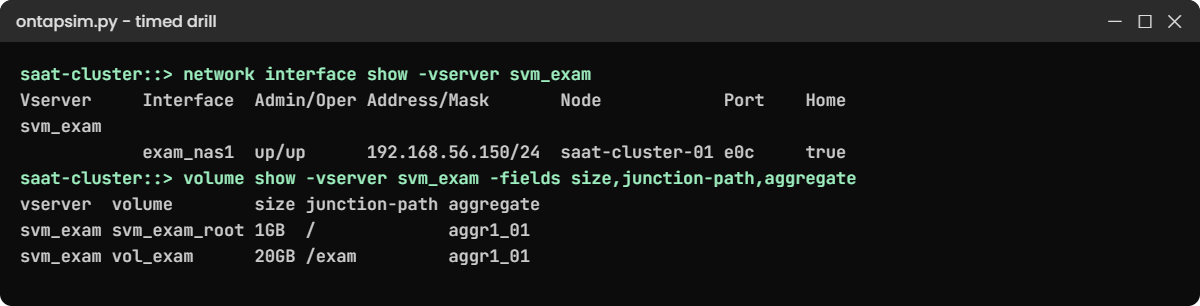
network interface show -vserver svm_examThe last command should show:
Logical Status Network Current Current Is
Vserver Interface Admin/Oper Address/Mask Node Port Home
----------- ---------- ---------- ------------------ --------------- ------- ----
svm_exam
exam_nas1 up/up 192.168.56.150/24 saat-cluster-01 e0c true✅ Checkpoint: exam_nas1 is up/up and home.
4Protect it (Data protection)
volume snapshot create -vserver svm_exam -volume vol_exam -snapshot drill1
volume snapshot show -vserver svm_exam -volume vol_exam
volume show -vserver svm_exam -fields size,junction-path,aggregateYou should see this:
---Blocks---
Vserver Volume Snapshot Size Total% Used%
-------- -------- ------------------------------------- -------- ------ -----
svm_exam vol_exam
drill1 0B 0% 0%
saat-cluster::> volume show -vserver svm_exam -fields size,junction-path,aggregate
vserver volume size junction-path aggregate
-------- ------------- ---- ------------- ---------
svm_exam svm_exam_root 1GB / aggr1_01
svm_exam vol_exam 20GB /exam aggr1_01
2 entries were displayed.Note your time. Under 20 minutes without notes means the commands are in your fingers; over 30 means repeat the Phase 1 and Phase 2 labs before booking.
✅ Checkpoint: Snapshot drill1 exists and you know how long the drill took.
Try it yourself: Open the cluster health check in the Command Builder.
Break It, Then Fix It
Exam questions love small details that break a command. Make two of them happen in the shell.
1Use a dash in a volume name
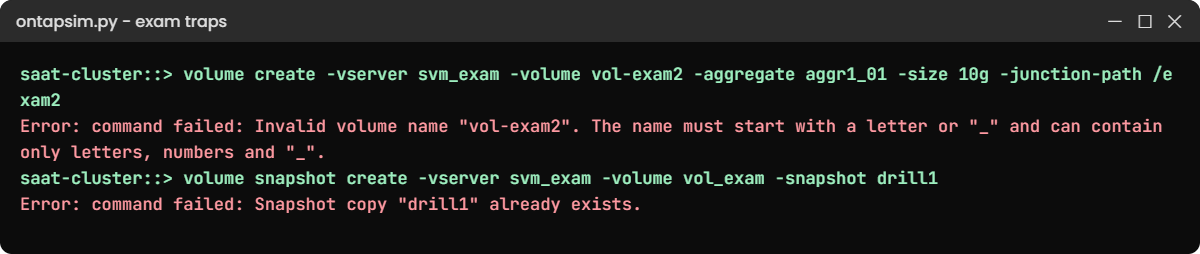
volume create -vserver svm_exam -volume vol-exam2 -aggregate aggr1_01 -size 10g -junction-path /exam2You’ll get this:
Error: command failed: Invalid volume name "vol-exam2". The name must start with a letter or "_" and can contain only letters, numbers and "_".Volume names allow letters, numbers and underscores only. Run it again as vol_exam2; the practice shell’s wording is ours, but real ONTAP rejects the dash too.
✅ Checkpoint: vol_exam2 is created.
2Reuse a snapshot name
volume snapshot create -vserver svm_exam -volume vol_exam -snapshot drill1You’ll get this:
Error: command failed: Snapshot copy "drill1" already exists.Snapshot names must be unique within a volume. Use a new name such as drill2, or a date in the name, which is also what scheduled snapshots do.
✅ Checkpoint: drill2 appears in volume snapshot show.
This happened at work
Second attempt, different method
A support engineer at an IT services firm in Puducherry failed his first NCDA attempt. He had read the official course slides twice and gone through hundreds of practice questions, but the real exam kept asking what to do next in situations he had never actually typed.
For the second attempt he changed his method: an hour a day in a lab, one exam area a week, and for every wrong practice answer he rebuilt that scenario and broke it on purpose. He also asked for the 30-minute extension, which he hadn’t known about the first time.
He passed the second time with time to spare, and his team now gives every new joiner the same plan: lab first, questions second.
Common mistakes and troubleshooting
| Mistake | What happens | Do this instead |
|---|---|---|
| Booking from an old exam code in a blog | You prepare for objectives that changed | Start from the certification page on netapp.com and the code shown in CertMetrics |
| Going straight to a specialist exam | The booking is blocked or the certification isn’t granted | Check the “required” line: SAN, Data Protection and MetroCluster need an active NCDA |
| Only reading slides and question banks | Scenario questions feel unfamiliar | Type every task in a lab and break it on purpose |
| Letting the NCDA expire before the NCIE | Linked renewal no longer works | Sit the NCIE while the NCDA is still active |
| Using exam dumps | Certifications can be revoked, and you can’t do the job | Use NetApp’s learning paths, prep videos and your own lab |
Interview questions
Click a question to open it. Each one is written the way an interviewer would ask it. Under it you will see why they ask it and one way you could answer, in your own words.
Fresher level
1. Which NetApp certification do you hold, and why did you choose it?
Why they ask this: They want to see that you picked a certificate for a reason that fits the job.
How you might answer: I hold the NCDA because I administer ONTAP every day, and it covers the core of that job: HA, SVMs, networking, protocols, protection, security and performance. My next one is the NCIE SAN ONTAP, because most of our tickets are block storage.
2. What is the difference between a professional and a specialist NetApp certification?
Why they ask this: They’re checking that you know the structure, not just one exam name.
How you might answer: Professional certifications prove a job role, like administrator or support engineer. Specialist ones go deeper in one area, like SAN, data protection or MetroCluster, and several need an active NCDA first.
2–5 years experience
3. How did you prepare for your last NetApp exam?
Why they ask this: They want to see a method that builds real skill.
How you might answer: I mapped each exam domain to tasks, practised them in a lab an hour a day, and rebuilt every question I got wrong as a lab scenario. In the last week I did timed drills, because the exam is scenario based.
4. Your NCDA expires next month. What can you do?
Why they ask this: They’re checking that you know the renewal rules.
How you might answer: Either retake the current NCDA exam, or pass a linked specialist exam such as NCIE SAN ONTAP, Data Protection or MetroCluster while the NCDA is still active. That renews the NCDA at the same time.
Senior level
5. How would you build a certification plan for a team of six storage engineers?
Why they ask this: They want to see you link certificates to the work the team actually does.
How you might answer: I’d start with NCDA for everyone, then split specialist exams by who owns what: SAN, data protection, MetroCluster or support. I’d book time for lab practice, track renewal dates so they don’t lapse, and tie the plan to upcoming projects.
6. Do certifications matter if an engineer has years of experience?
Why they ask this: They’re testing a balanced view.
How you might answer: Experience matters more, but a current certificate proves the person knows today’s features, like ransomware protection or S3, not only what they used years ago. Many partner programmes and tenders also require certified staff.
Quick quiz
Q1. How long does a NetApp certification stay active?
- 12 months
- 24 months
- 36 months
- For life
Show answer
B — NetApp’s policy says certifications are active for 24 months.
Q2. Which exam needs an active NCDA first?
- Technology Solutions Professional
- Hybrid Cloud Administrator
- Implementation Engineer, SAN ONTAP
- AI Expert
Show answer
C — the SAN, Data Protection and MetroCluster specialist exams require the NCDA.
Q3. Who delivers NetApp exams?
- Prometric
- Pearson VUE, in a centre or online with OnVUE
- NetApp support engineers
- Credly
Show answer
B — Pearson VUE runs the exams; Credly only issues the badge.
Q4. What does the AI Data Infrastructure Expert need?
- One exam called NS0-950
- AI Expert, NCDA and an NVIDIA AI exam
- Only the NCDA
- A FlexPod exam
Show answer
B — it’s a combined badge earned from three exams.
Q5. After you pass an exam, when can you sit it again?
- Next day
- After 14 days
- After 12 months
- Never
Show answer
C — a candidate who passes must wait 12 months.
Quick recap
- NetApp has about 20 certifications at professional, specialist and expert level.
- Most ONTAP careers start with the NCDA, then one specialist exam that matches the job.
- Exams cost US$200 (FlexPod US$300, expert US$250) and run on Pearson VUE or OnVUE.
- Certifications last 24 months; a linked specialist exam renews the NCDA.
- Always confirm the current exam code and objectives on netapp.com before you book.
What’s next
Go back to the NetApp ONTAP Storage Administration course page to pick the lessons for your chosen exam, or keep practising with your own values in the Command Builder ONTAP tab.
Further reading: NetApp certification
NetApp’s certification list has a page per exam with its objectives. The certification programme policies cover prices, validity and retakes, and you book through Pearson VUE.
You can also see the full plan for this course on the NetApp ONTAP Storage Administration course page.
