DS8000 interview questions

These DS8000 interview questions are the ones storage teams really ask, from a fresher’s first screening call to a senior architect panel. Over this course you’ve built, mirrored, upgraded, monitored and fixed a DS8000, and this last lesson turns that work into answers an interviewer will trust.

You’ll see how a DS8000 interview usually runs, what each level is actually testing, and how to answer with commands and numbers instead of buzzwords. The lab is a “practical round”, the hands-on test many banks give now, on the SaatBank system from Lesson 31, and Break It walks you through the trick questions where candidates slip most often.

Keep your Lesson 31 notes close by, because the stories you wrote there are your best interview material.

TimeYou needBy the end you can
60 to 90 minutesThe SaatVedha practice shell, the build script below and a notebook for your answersAnswer fresher, mid-level and senior DS8000 questions with commands and numbers, pass a hands-on practical round, and avoid the classic trick questions

What it is, in one line

A DS8000 interview checks that you understand how the box works, that you can run it safely with the DS CLI, and that you stay calm and methodical when something breaks.

In Simple Words

The driving test

A driving test comes in two parts. First the examiner asks questions, like what a sign means or who goes first at a roundabout, and then you drive while the examiner watches how you check your mirrors, not how fast you go. Nobody fails for not knowing the engine’s part numbers, but people do fail for not looking before they turn.

A DS8000 interview works the same way. The questions check you understand the rules, and the practical round watches whether you check before you change, so show them you look in the mirror every time.

Engineer's View

What each level is really testing

Fresher (0 to 2 years). Can you explain the architecture in plain words: two CPCs (server0 and server1), cache and NVS, host adapters, HPFE Gen3 flash, and the HMCs sitting outside the data path? And do you know the configuration chain of array site, array (RAID 6 or RAID 10), rank, extent pool, volume, volume group and host?

Can you run lssi, lsserver and lsfbvol and make sense of what they print?

2 to 5 years. Can you make real changes safely? That means creating and mapping volumes, growing them, deleting with rmfbvol -safe, setting up FlashCopy with -record -persist, building Metro Mirror paths and pairs, planning a code upgrade and troubleshooting by layers. Interviewers listen for the even and odd LSS rules, two paths on two adapters, and checks before every change.

Senior. Can you design and lead? Think sizing with IBM Storage Modeller, splitting workloads across rank groups, choosing Metro Mirror, Global Mirror or both, planning Safeguarded Copy and a ransomware response, running code loads across many systems and leading a bridge call. Expect “what would you do differently” and trade-off questions.

Facts worth knowing cold. The G10 models are DS8A10, DS8A50 and DS8A80 (machine type 5341). RAID 6 is the default, and RAID 5 isn’t supported.

FB extents are 16 MiB or 1 GiB. LUNs go up to 16 TiB and Copy Services up to 4 TiB, and a source can have up to 12 FlashCopy relationships.

Safeguarded Copy capacity needs a multiplier of at least 1.5, and the backups are created by CSM or GDPS, not by the DS CLI.

How it works, step by step

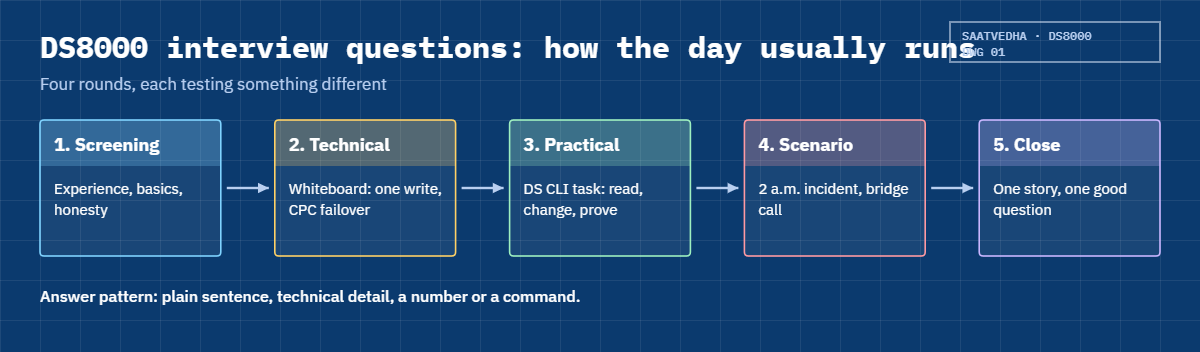
Most DS8000 interviews follow the same shape, and once you know it half the nerves go away.

1The screening call

This is fifteen minutes with HR or a team lead about your experience, which storage you’ve worked on, and two or three basics. Be honest about lab versus production experience, because for a fresher, “I built and broke a DS8000 setup in a practice environment, step by step” is a strong answer.

2The technical round

One or two engineers ask concept and scenario questions, often at a whiteboard where you draw the box, follow a single write and fail a CPC. They’ll keep asking “why?” until you hit the edge of what you know.

DS8000 interview questions: screening, technical, practical, scenario and close

3The practical round

More teams now set a lab task, such as “here is a DS CLI session, create a volume and map it” or “find out why this host sees nothing”. They watch the order you work in as closely as the result.

4The scenario or bridge-call round

This one’s for mid and senior roles: “It’s 2 a.m., the mirror is suspended and the business wants answers.” They’re testing how calm you are, your method, and how you communicate.

5Answer in a pattern

For a concept question, give one plain sentence, then the technical detail, then a number or a command. For a scenario question, say what you’d check first, then what you’d change, and then how you’d prove it worked.

6When you don’t know

Say so, and then show how you’d find out: “I haven’t used that flag, but I’d check help mkpprc and IBM’s command reference, and try it in a lab first.” Interviewers trust that far more than a confident guess.

Four classic DS8000 interview trap questions and good answers

7Close with a story

When they ask “anything else?”, tell one short incident story covering symptom, layer, cause, fix and proof. Your Lesson 31 drills have given you ten of those.

Finish by asking them something real, like how they monitor mirror states or how often they run DR tests. Good questions show you’ve done the job, even if it was only in a lab.

Hands-on lab: a DS8000 practical interview round

Before you run any command, double-check it

Read every command twice before you press Enter. Check the target: the system or account, the IDs, the names and the sizes. These commands are for learning and were tested in our lab, not on your system. At work, run the read-only list commands first, follow your change process, make sure a backup exists, and ask a second person to check anything that changes or deletes data. You run them at your own risk.

This is what a typical practical round looks like. The interviewer hands you a DS CLI session on a working system and asks you to describe it, and they want short, confident readings of real output.

You’ll use the SaatBank build from Lesson 31.

Practice shell note: the practice shell is our teaching tool, not IBM software, and real DS CLI output is close but not identical. Wide outputs are shortened, and CMUN02039E is a practice shell message.

1Set up the system

build-26.txt (same as build-25.txt):

# build-26.txt: the SaatBank build from Lesson 31 (Lesson 32 practical round)
mkarray -raidtype 6 -arsite S1
mkarray -raidtype 6 -arsite S2
mkrank -array A0 -keygrp 1 -stgtype fb
mkrank -array A1 -keygrp 1 -stgtype fb
mkextpool -rankgrp 0 -keygrp 1 -stgtype fb SB_FB_0
mkextpool -rankgrp 1 -keygrp 1 -stgtype fb SB_FB_1
chrank -extpool P0 R0
chrank -extpool P1 R1
mkfbvol -extpool p0 -cap 100 -sam ese -name core_#h 2000-2001
mkfbvol -extpool p1 -cap 100 -sam ese -name web_#h 2100-2101
mkfbvol -extpool p0 -cap 100 -sam ese -name core_copy_#h 2010
mkhost -type "Linux Server" -hostport 10000090FA13B914,10000090FA13B915 core-db1
mkhost -type "Windows Server" -hostport 21000024FF2D0F86,21000024FF2D0F87 web-app1
chhost -action map -volume 2000,2001 core-db1
chhost -action map -volume 2100,2101 web-app1
mkflash -record -persist 2000:2010
mkfbvol -dev IBM.2107-78SV002 -extpool p0 -cap 100 -name dr_core_#h 2000
mkpprcpath -remotedev IBM.2107-78SV002 -remotewwnn 5005076303FFF1DD -srclss 20 -tgtlss 20 I0030:I0130 I0052:I0152
mkpprc -remotedev IBM.2107-78SV002 -type mmir -mode full 2000:2000
simctl tick 3
chsp -snmp on -snmpaddr 10.20.30.40,10.20.30.41

Run this:

python ds8sim.py   (then: simctl reset, quit)
python ds8sim.py -hmc1 10.0.0.1 -user admin -script build-26.txt
python ds8sim.py

✅ Checkpoint: the build ends with CMUC00040I.

2Task: “What system is this and what code is it on?”

Run these:

ver -l
lssi

You should see this:

dscli> ver -l
Date/Time: 24 October 2026 14:10:38 UTC IBM DSCLI Version: 7.10.10.348 DS: IBM.2107-78SV001
DSCLI 7.10.10.348
StorageManager 10.2.2507181727
HMC DSCLI 7.10.10.348
==================Version==================
Storage Image    LMC         Bundle Version
===========================================
IBM.2107-78SV001 7.10.10.348 10.10.106.0
dscli> lssi
Date/Time: 24 October 2026 14:10:38 UTC IBM DSCLI Version: 7.10.10.348 DS: IBM.2107-78SV001
Name         ID               Storage Unit     Model WWNN             State  ESSNet
====================================================================================
ds8k-g10-lab IBM.2107-78SV001 IBM.2107-78SV000 A05   5005076303FFF0DD Online Enabled

Your answer: “A DS8A50, model A05, storage image IBM.2107-78SV001, Online, running bundle 10.10.106.0, which is Release 10.1. DS CLI 7.10.10.348 matches the LMC.”

✅ Checkpoint: you named model, ID, state and release in one sentence.
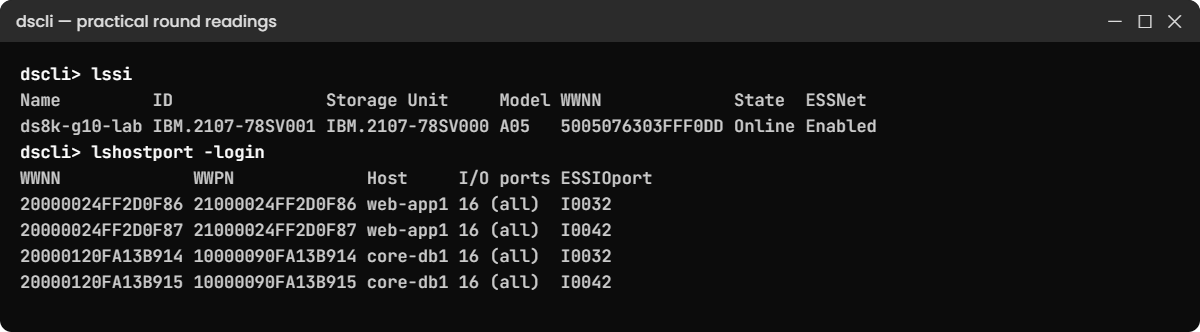
Practice shell practical round: lssi and host logins
Two of the outputs you read aloud in the practical round.

3Task: “Are both servers healthy?”

Run this:

lsserver -l

You should see this:

dscli> lsserver -l
Date/Time: 24 October 2026 14:10:38 UTC IBM DSCLI Version: 7.10.10.348 DS: IBM.2107-78SV001
ID      Image ID         Image Name   Power Control SFI State LIC Version OS Version Bundle Version
===================================================================================================
server0 IBM.2107-78SV001 ds8k-g10-lab Online        Online    7.10.10.348 AIX 7.3    10.10.106.0
server1 IBM.2107-78SV001 ds8k-g10-lab Online        Online    7.10.10.348 AIX 7.3    10.10.106.0

Your answer: “Both server0 and server1 are Online, on the same LIC and bundle, so no code load is half done and no failover is active.”

✅ Checkpoint: you checked state and level for both servers.

4Task: “Describe the volumes.”

Run this:

lsfbvol 2000-2101

You should see this:

dscli> lsfbvol 2000-2101
Date/Time: 24 October 2026 14:10:38 UTC IBM DSCLI Version: 7.10.10.348 DS: IBM.2107-78SV001
Name           ID   accstate datastate configstate deviceMTM datatype extpool cap (2^30B) cap (10^9B) cap (blocks)
==================================================================================================================
core_2000      2000 Online   Normal    Normal      2107-900  FB 512   P0      100.0       -           209715200
core_2001      2001 Online   Normal    Normal      2107-900  FB 512   P0      100.0       -           209715200
core_copy_2010 2010 Online   Normal    Normal      2107-900  FB 512   P0      100.0       -           209715200
web_2100       2100 Online   Normal    Normal      2107-900  FB 512   P1      100.0       -           209715200
web_2101       2101 Online   Normal    Normal      2107-900  FB 512   P1      100.0       -           209715200

Your answer: “Five 100 GiB FB volumes. 2000, 2001 and 2010 are in P0, on even LSS 20, so server0. 2100 and 2101 are in P1, odd LSS 21, server1. The work is split across both servers.”

✅ Checkpoint: you linked LSS parity to pool and server.

5Task: “Can core-db1 see its disks, and how many paths does it have?”

Run these:

showhost core-db1
lshostport -login

You should see this:

dscli> showhost core-db1
Date/Time: 24 October 2026 14:10:38 UTC IBM DSCLI Version: 7.10.10.348 DS: IBM.2107-78SV001
Name          core-db1
Type          Linux Server
State         Online
AddrMode      scsimap256
Volumes       2
Host ports    2
I/O ports     16 (all)
AddrDiscovery lunpolling
LBS           512
Cluster       -
dscli> lshostport -login
Date/Time: 24 October 2026 14:10:38 UTC IBM DSCLI Version: 7.10.10.348 DS: IBM.2107-78SV001
WWNN             WWPN             Host     I/O ports ESSIOport
==============================================================
20000024FF2D0F86 21000024FF2D0F86 web-app1 16 (all)  I0032
20000024FF2D0F87 21000024FF2D0F87 web-app1 16 (all)  I0042
20000120FA13B914 10000090FA13B914 core-db1 16 (all)  I0032
20000120FA13B915 10000090FA13B915 core-db1 16 (all)  I0042

Your answer: “core-db1 is Online with 2 volumes. Its two WWPNs are logged in on I0032 and I0042, which are on different host adapters, so it has two paths and survives an adapter failure.”

✅ Checkpoint: you mentioned volumes, logins and adapter separation.

6Task: “Any capacity risk?”

Run this:

lsextpool

You should see this:

dscli> lsextpool
Date/Time: 24 October 2026 14:10:38 UTC IBM DSCLI Version: 7.10.10.348 DS: IBM.2107-78SV001
Name    ID stgtype rankgrp status availstor (2^30B) %allocated available reserved numvols
=========================================================================================
SB_FB_0 P0 fb      0       below  99576             0          6372864   64       3
SB_FB_1 P1 fb      1       below  99576             0          6372864   64       2

Your answer: “Both pools are below threshold with about 99,576 GiB available each. The volumes are thin, so I’d still watch growth trends rather than trust today’s number.”

✅ Checkpoint: you read status and availstor.

7Task: “Is data protected?”

Run these:

lsflash -l 2000:2010
lspprc -l 2000

You should see this:

dscli> lsflash -l 2000:2010
Date/Time: 24 October 2026 14:10:38 UTC IBM DSCLI Version: 7.10.10.348 DS: IBM.2107-78SV001
ID        SrcLSS SequenceNum Timeout ActiveCopy Recording Persistent
====================================================================
2000:2010 20     0           120     Disabled   Enabled   Enabled
(output shortened)
dscli> lspprc -l 2000
Date/Time: 24 October 2026 14:10:38 UTC IBM DSCLI Version: 7.10.10.348 DS: IBM.2107-78SV001
ID        State       Reason Type         Out Of Sync Tracks
============================================================
2000:2000 Full Duplex -      Metro Mirror 0
(output shortened)

Your answer: “2000 has an incremental FlashCopy to 2010 (Recording and Persistent Enabled), so refreshes copy only changes. It’s also mirrored with Metro Mirror and is Full Duplex with 0 out-of-sync tracks. I’d also want Safeguarded Copy from CSM for ransomware protection, which this lab doesn’t show.”

✅ Checkpoint: you covered local copy, remote copy and the missing piece.

8Score yourself

Time each answer. A good one takes 20 to 40 seconds and has at least one number or command in it. Record yourself on your phone once, and you’ll hear every “umm” and every vague word.

✅ Checkpoint: every answer had a fact from the output.

Break It, Then Fix It

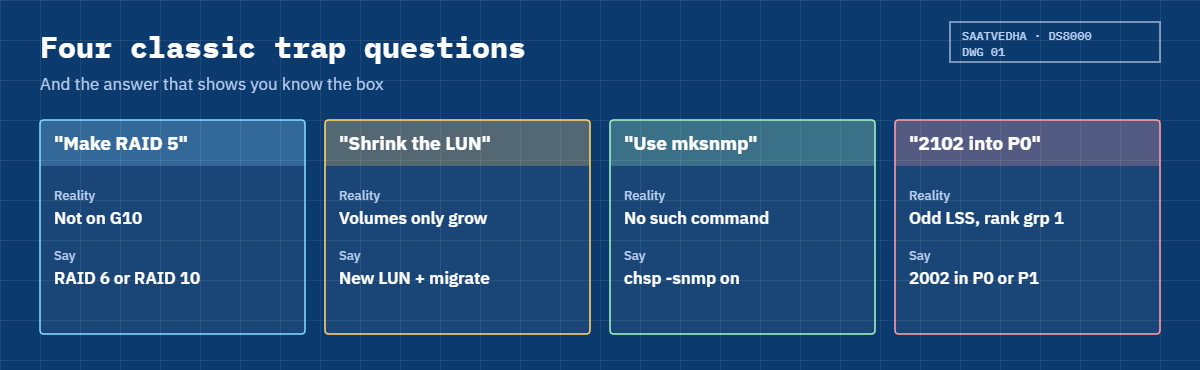
Interviewers love questions with a trap in them. Here are four classic ones, each tested in the practice shell on the same SaatBank system.

1Trap: “Create a RAID 5 array for us.”

Run this (answer y to the disclaimer):

mkarray -raidtype 5 -arsite S3

You’ll get this:

dscli> mkarray -raidtype 5 -arsite S3
CMUC00536W mkarray: The use of RAID 6 over RAID 5 is highly recommended for increased reliability. Please acknowledge that you understand the risks associated with RAID 5.: Are you sure you want to accept the disclaimer above? [Y/N]: y
CMUN81522E mkarray: RAID 5 is not supported by the device adapter pair.

What to say: “DS8A00 supports RAID 6, the default, and RAID 10. RAID 5 isn’t supported on G10, so I’d use RAID 6, or RAID 10 for heavy random writes.”

✅ Checkpoint: you know the G10 RAID options.

2Trap: “Shrink this LUN to 50 GiB, it’s too big.”

Run this:

chfbvol -quiet -cap 50 2000

You’ll get this:

dscli> chfbvol -quiet -cap 50 2000
CMUN02039E chfbvol: 2000: The new capacity must be larger than the current capacity. A volume cannot be reduced in size.

What to say: “A DS8000 volume can’t shrink. I’d create a 50 GiB volume, let the host team migrate the data, then delete the old one with rmfbvol -safe.”

✅ Checkpoint: you offered the safe alternative.
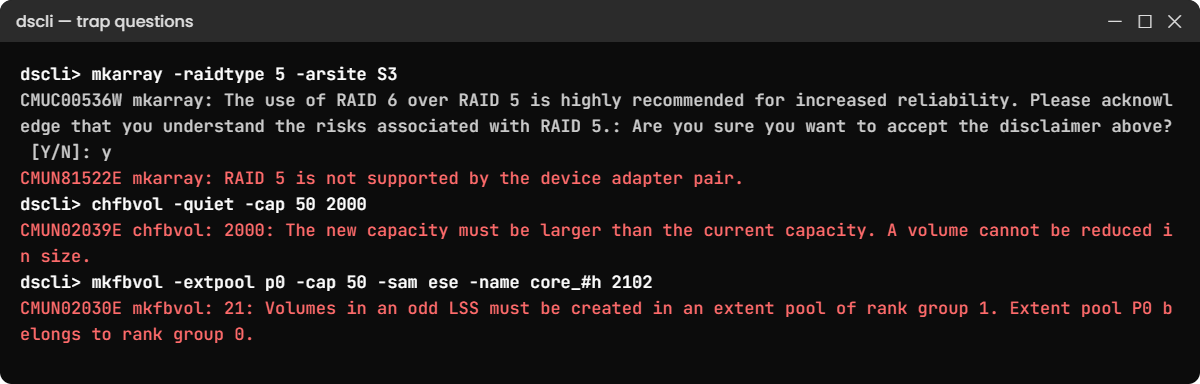
Practice shell trap questions: RAID 5, shrink and odd LSS in an even pool
Three traps and the real DS8000 responses.

3Trap: “Set up SNMP with mksnmp.”

Run this:

mksnmp -addr 10.20.30.40

You’ll get this:

dscli> mksnmp -addr 10.20.30.40
CMUN00014E mksnmp: Unknown command. Enter "help" for a list of commands.

What to say: “There’s no mksnmp on a DS8000. Operational traps are set with chsp -snmp on -snmpaddr with up to two addresses, and hardware trap 3 is set on each HMC.”

✅ Checkpoint: you named chsp and the HMC setting.

4Trap: “Put a new core banking volume 2102 in pool P0.”

Run this:

mkfbvol -extpool p0 -cap 50 -sam ese -name core_#h 2102

You’ll get this:

dscli> mkfbvol -extpool p0 -cap 50 -sam ese -name core_#h 2102
CMUN02030E mkfbvol: 21: Volumes in an odd LSS must be created in an extent pool of rank group 1. Extent pool P0 belongs to rank group 0.

What to say: “2102 is in LSS 21, which is odd, so it belongs to rank group 1. P0 is rank group 0. I’d either use 2002 in P0 or 2102 in P1, depending on which server should carry it.”

✅ Checkpoint: you explained even and odd LSS to rank group.

This happened at work

The candidate who said “I would check first”

A large insurer was hiring a DS8000 engineer, and two candidates made it to the final panel. The first had eight years of experience and reeled off model numbers, feature codes and every Copy Services acronym there is.

The second had two years, mostly on a smaller system, plus a lab where she’d built and broken a DS8000 setup many times over.

The panel’s practical task was “A host lost one of its LUNs after a cleanup ticket. Fix it.” The experienced candidate went straight to a chhost -action map for the volume he guessed, and he guessed the wrong one.

The second candidate said “Before I change anything, I’ll check,” and ran showhost and lsfbvol -volgrp. She compared them with the ticket, found the missing volume, mapped it, and showed the host’s volume count going from 1 to 2, then added that she’d ask the host team to rescan and confirm.

She got the job, and the hiring manager’s note read: “Checks before changes. Proves every fix. I can trust her at 3 a.m.”

The lesson: interviews for storage roles reward safe habits more than long lists of facts, so let them see you look before you act.

Common mistakes and troubleshooting

Interview mistakeWhy it hurtsDo this instead
Listing features without explaining themSounds memorised, not understoodOne plain sentence, then detail, then a number or command.
Guessing a command or flagOne wrong flag makes them doubt the restSay how you’d check: help, IBM docs, a lab test.
Jumping to a fix in a scenarioLooks risky in productionStart with scope and checks; fix one thing; prove it.
Saying “the DS CLI takes Safeguarded backups”Common misconceptionCapacity with managefbvol; backups and recovery in CSM or GDPS.
Forgetting the host sideHalf of every storage issue is on the hostMention multipath, rescans and the host team every time.
No storiesAnswers feel theoreticalPrepare three short incident stories with symptom, cause, fix and proof.

Practise out loud. Answers feel fine when you read them silently, but saying them against the clock shows you where you hesitate.

Interview questions

Click a question to open it. They’re worded the way an interviewer would ask them, and under each one you’ll find why they ask it and one way you could answer in your own words.

Fresher level

1. Draw a DS8000 on the whiteboard and follow one host write.

Why they ask this: It’s the classic opener, and it checks you really understand cache, NVS and the two servers.

How you might answer: I’d draw two CPCs, server0 and server1, with host adapters and I/O enclosures in front and HPFE flash behind. A write comes in on a host adapter port and goes to the server that owns the volume’s LSS (even to server0, odd to server1). It lands in that server’s cache, and a copy goes into the other server’s NVS.

Once both copies exist, the host gets “done”, and destage to RAID 6 flash happens later. The HMCs sit outside the data path.

2. What is the order of objects you create to give a host a LUN?

Why they ask this: They want the configuration chain in the right order, which is a basic sign you’ve done hands-on work.

How you might answer: Array site first, then an array with mkarray (RAID 6 by default), a rank with mkrank, an extent pool with mkextpool and chrank -extpool, and volumes with mkfbvol. After that a host with its WWPNs (mkhost, mkhostport) and the mapping with chhost -action map, which uses a volume group underneath.

2–5 years experience

3. A host can’t see a LUN you just mapped. Walk me through it.

Why they ask this: They want a layered method with real commands, not a guess.

How you might answer: I’d first confirm the mapping with showhost and showvolgrp, then check lshostport -login to see whether the host’s WWPNs are logged in, and lsioport for port state and topology.

If logins are missing but the ports are healthy, it’s zoning or the HBA, so the SAN team takes a look. If everything’s fine on the DS8000, the host needs a rescan and a multipath reload, and I’d confirm with the host team that the new disk shows on all paths.

4. Metro Mirror or Global Mirror for a DR site 600 km away? Why?

Why they ask this: It tests whether you understand distance, latency and consistency.

How you might answer: Global Mirror. Metro Mirror is synchronous, so every write waits for the round trip, and at 600 km that latency would hurt the application. Global Mirror sends data asynchronously and forms consistency groups with FlashCopy at the DR site, so the DR data is consistent and only a few seconds behind. Plenty of banks run Metro Mirror to a nearby site and Global Mirror further out.

Senior level

5. Design storage protection against ransomware for a bank running on DS8000.

Why they ask this: At senior level you have to bring together prevention, detection, immutable copies and recovery you’ve practised.

How you might answer: I’d run Safeguarded Copy through CSM on a schedule, with agreed retention and recovery volumes built in advance. On top of that, Ransomware Threat Detection on FCM4 with Storage Insights Pro alerts feeding the SOAR tool, and named users with least privilege plus Dual Control for risky changes.

The runbook would cover isolate, capture, examine and restore, including what to do about Metro Mirror so we don’t copy corruption to DR, and we’d rehearse it twice a year.

6. How do you plan DS8000 code upgrades across ten systems with replication?

Why they ask this: They want risk-aware planning, the right order of work, and verification.

How you might answer: I’d follow IBM’s code recommendation, keep the systems within supported levels of each other, and do DR before production. Every system gets its HMC update a day or two early, pre-checks, our own host path checks (two paths on two adapters), and mirror state checks before and after. I’d download once using the HMC Code Image Server, and record ver -l and lsserver -l before and after each upgrade.

Quick quiz

Q1. Which RAID types does a DS8A00 support?

  1. RAID 5 and RAID 6
  2. RAID 6 and RAID 10
  3. RAID 0 and RAID 1
  4. Only RAID 10
Show answer

B — RAID 6 is the default; RAID 10 is the other option. RAID 5 is rejected.

Q2. A volume in LSS 21 belongs to which rank group and server?

  1. Rank group 0, server0
  2. Rank group 1, server1
  3. Either
  4. The HMC
Show answer

B — Odd LSSs belong to rank group 1 and server1.

Q3. What is the best first answer to “the host can’t see its disks”?

  1. Reboot the DS8000
  2. Check scope, mapping and logins before changing anything
  3. Delete and recreate the host
  4. Increase the LUN size
Show answer

B — Interviewers want checks before changes.

Q4. Which is true about Safeguarded Copy on DS8000?

  1. mksafeguardedcopy creates backups
  2. DS CLI manages capacity; CSM or GDPS create and recover backups
  3. It needs RAID 5
  4. It is the same as Metro Mirror
Show answer

B — Backups are created and recovered by CSM or GDPS.

Q5. What should a good scenario answer always include?

  1. A list of features
  2. What you check, what you change and how you prove it
  3. The DS8000 price
  4. Only the final command
Show answer

B — Check, change and proof show safe habits.

Quick recap

  • Interviews test understanding, safe hands-on habits and calm troubleshooting.
  • Answer in a pattern: plain sentence, technical detail, a number or command.
  • In practical rounds, read outputs out loud with facts: model, state, LSS, paths, pool status, copy state.
  • Know the classic traps: no RAID 5, no shrink, no mksnmp, even and odd LSS rules, Safeguarded backups via CSM.
  • Bring three short incident stories with symptom, cause, fix and proof.

What’s next

That’s the IBM DS8000 Implementation course finished. You can now plan, build, protect, upgrade, monitor and troubleshoot a DS8000, and explain all of it in an interview. Head back to the IBM DS8000 Implementation course page to review any lesson, and keep practising with the practice shell drills.

Further reading: DS8000 interview questions

Want to go deeper into DS8000 interview questions? For the deepest technical reference, keep the IBM Storage DS8A00 Architecture and Implementation Guide (IBM Redbooks) close. For whiteboard practice on the hardware, revisit Architecture interview prep and whiteboard drill.

You can also see the full plan for this course on the IBM DS8000 Implementation course page.

Scroll to Top

This website uses cookies

We use a few cookies to keep this site working. If you allow it, we also use Google Analytics to count visits so we can improve our lessons. You can accept all, deny the optional ones, or choose what to allow.