
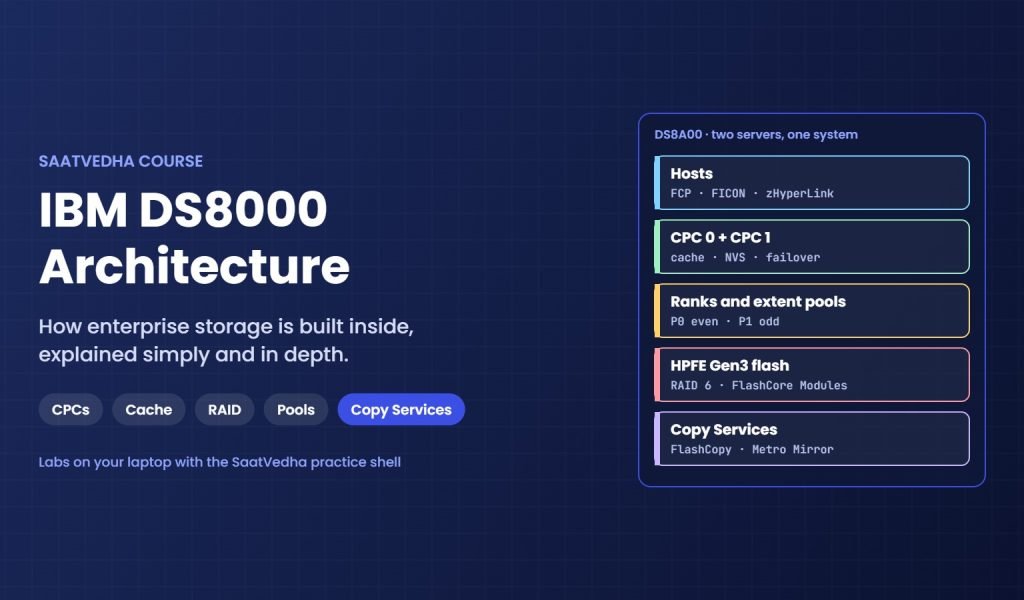
IBM DS8000 architecture is how IBM’s enterprise storage system is built inside: two Power servers that share the work, cache and NVS that protect every write, flash enclosures, and the layers that turn drives into the LUNs your servers see. Banks, airlines and IBM Z shops trust it with their most important data, so the people who run it are expected to know how it works, not only which button to press.
This course explains the DS8000 G10 family (DS8A10, DS8A50 and DS8A80) from the outside in. You start with the frame and its parts, then follow the virtualization chain step by step: array sites, arrays, ranks, extent pools, volumes, LSSs and volume groups. Every idea comes with a simple everyday comparison first, then the real engineering detail.
The last phase covers what keeps data safe: failover and failback between the two servers, Copy Services such as FlashCopy and Metro Mirror, encryption, and Safeguarded Copy against ransomware. You finish with an interview drill where you draw the whole architecture on a whiteboard.
What you need: a laptop with Python 3 and, for a few labs, VirtualBox with Ubuntu. You don’t need a real DS8000. Lesson 1 gives you the SaatVedha practice shell, a small program that behaves like the DS CLI, so you can build arrays, ranks and pools yourself. Where a real screen matters, the lesson shows it with a clear label.
Who This Course Is For
- Storage and SAN engineers who are starting to support IBM DS8000 systems
- Freshers aiming for a storage administrator job in a bank or large data centre
- IBM Z and AIX teams who want to understand the storage under their volumes
- Engineers who know other arrays and want to map what they already know
- Anyone preparing for DS8000 interviews
What You Will Learn
By the end of this course, you will be able to:
- Name every main DS8000 hardware part and say what happens when it fails
- Explain how cache, NVS and NVDIMM keep writes safe during a power loss
- Follow the virtualization chain from drives to the LUN a host sees
- Choose RAID 6 or RAID 10, small or large extents, and plan balanced extent pools
- Explain FB and CKD volumes, LSSs, LCUs and address groups
- Describe FlashCopy, Metro Mirror, Global Mirror and Safeguarded Copy, and when each is used
- Answer DS8000 architecture interview questions with confidence
Why Learn IBM DS8000 Architecture?
The DS8000 runs the systems a company can’t afford to lose: core banking, card payments, airline bookings and most IBM Z workloads. When something goes wrong at 2 a.m., the team needs someone who knows why a pool is full, why a host lost half its paths, or what a server failover really did.
Companies don’t hire for that by checking if you can click through a GUI. They ask how the two servers share the work, what happens to a write before it reaches flash, and why volume 2100 can’t come from pool P0.
This course gives you those answers in plain words, with the real terms you’ll hear at work and labs you can repeat on your own laptop.
- Get hired for storage administrator roles in banks and large enterprises
- Understand the DS8000 terms that confuse most people at first
- Plan layouts that spread the work across both servers
- Talk to IBM support and your team using the right words
- Get ready for the IBM DS8000 Implementation course
Course Meta Information
Estimated Time: 29 lessons, about 29 hours
Difficulty: Beginner
Tracks: Storage
Categories: SAN (Storage Area Network) Storage, Storage
Further reading: IBM DS8000 architecture
IBM’s official guide for this family: IBM Storage DS8A00 Architecture and Implementation Guide (IBM Redbooks).
New to storage? Start with our SAN Storage course and FC Fundamentals course. When you finish here, the IBM DS8000 Implementation course shows you how to build it all with the DS CLI.
-
Phase 0: Start here
-
Phase 1: The hardware
-
Phase 2: Virtualization
-
Phase 3: Resilience and data protection
-
Phase 4: Generations, models and rack layouts
-
Phase 5: Wrap-up