
- You must enroll in this course to access course content.
Imagine you hired a very well-read assistant who has studied millions of books, websites, and documents. You ask them a question, and they respond in plain English — not by looking up an answer, but by *generating* one based on everything they’ve absorbed. That is the basic idea behind **Generative AI**. Unlike traditional software that follows rigid rules, Generative AI creates new content — text, code, summaries, even images — based on patterns learned from massive datasets.
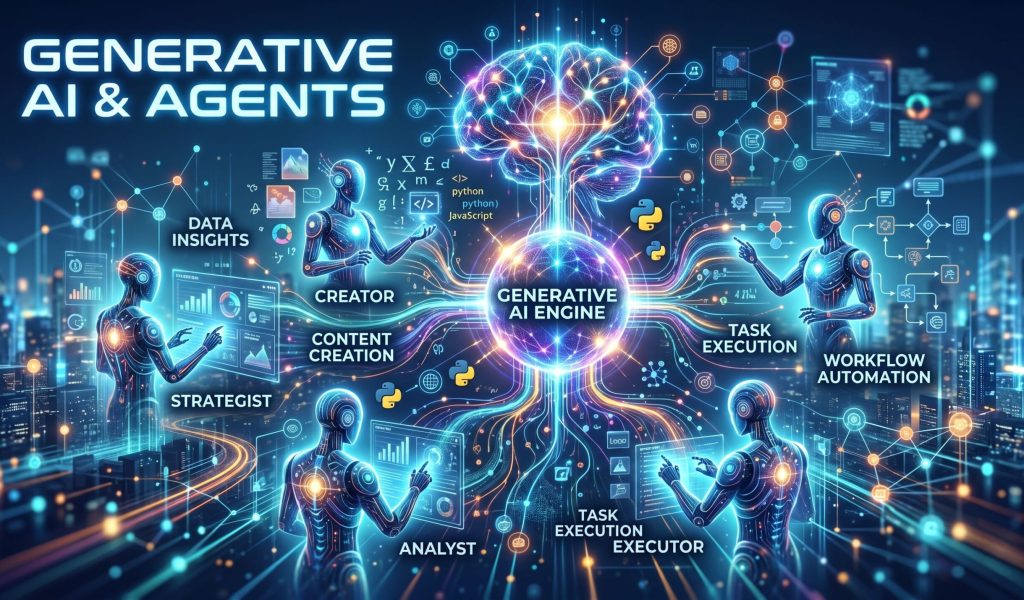
Now take it one step further. What if that assistant could not only answer questions but also *take action* — browsing the web, running a script, sending an email, or calling an API to complete a task on your behalf? That is where **AI Agents** come in. Agents are AI systems that can reason, plan, and execute multi-step tasks with minimal human intervention.
This course introduces you to the foundational concepts behind Generative AI and agentic systems, with a focus on how these technologies are implemented and consumed through **AI services**. Whether you are a developer, cloud engineer, or IT professional curious about AI, this module gives you the vocabulary, mental models, and technical grounding to move forward confidently.
Who This Course Is For
- Cloud engineers and architects exploring AI capabilities
- IT professionals preparing for **AI** certifications
- Developers building intelligent applications on AI
- System administrators curious about integrating AI into existing workflows
- Students and beginners with no prior AI experience
What You Will Learn
By the end of this course, you will be able to:
- Understanding of Generative AI fundamentals
- Knowledge of Large Language Models (LLMs)
- Hands-on experience with prompts and AI interactions
- Introduction to AI agents and automation concepts
- Real-world use cases across industries
- Skills that are highly in demand in modern IT careers
Why Learn Generative AI & Agents?
Generative AI is transforming the way businesses, developers, and individuals work by enabling intelligent systems that can create content, answer questions, automate tasks, and improve productivity. Learning Generative AI helps you understand the technology behind modern AI tools such as chatbots, virtual assistants, content generators, and AI-powered automation platforms.
In this course, you will learn the core concepts of Generative AI, including Large Language Models (LLMs), prompt engineering, and AI agents. You will gain practical knowledge on how AI models understand human language, generate responses, and assist in solving real-world problems.
- Improve productivity and automation
- Build intelligent AI-powered applications
- Enhance problem-solving skills
- Stay updated with the latest technology trends
- Increase career opportunities in AI and IT industries
Course Meta Information
Difficulty: Beginner
Categories: AI
-
Introduction to generative AI and agents
- Introduction to generative AI and agents
-
Large language models (LLMs)
- Large language models (LLMs)
- Tokenization
- Transforming tokens with a transformer
- Initial vectors and positional encoding
- Attention and embeddings
- Predicting completions from prompts
-
Prompts
- Prompts
- Types of prompt
- Conversation history
- Retrieval augmented generation (RAG)
- Tips for better prompts
-
AI agents
- AI agents
- Components of an AI agent
- Multi-agent systems